You’re about to pour a slab, build a driveway, or dig footings — and now you realize you have no idea how much concrete to order. That feeling? I’ve been there. Get the math wrong and you either run short mid-pour (a nightmare) or pay for a half-yard you didn’t need. This guide gives you the exact formula, real examples, and all the little tricks that save both time and money.
When people say “calculate concrete,” they really mean one thing: figuring out the volume of material needed to fill a space. It sounds simple, but many first-timers confuse area with volume — and that one mistake can ruin an entire project.
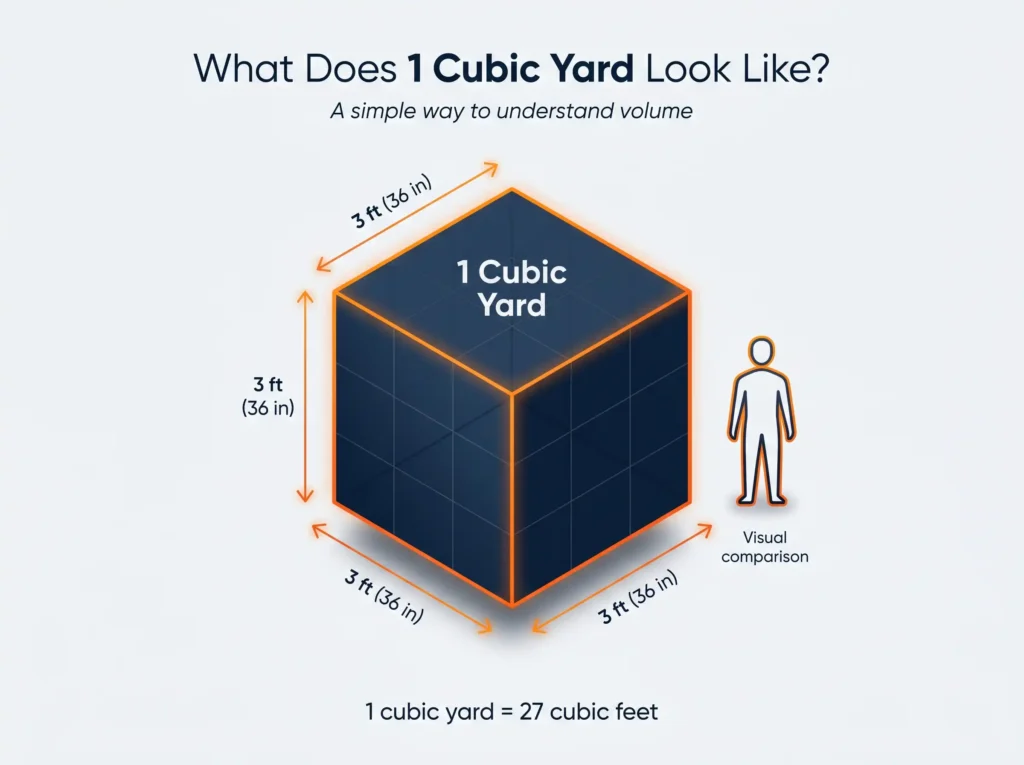
Ready-mixed concrete is sold by the cubic yard in the United States. A cubic yard is just a cube that is 3 feet long, 3 feet wide, and 3 feet tall, which equals 27 cubic feet. Suppliers and batch plants use this unit because it makes large bulk delivery amounts easy to price and manage.
Think of it like ordering water by the gallon instead of by the drop. It just makes the numbers manageable.
Here’s where a lot of people go wrong. Square footage measures a flat surface — like the floor of a room. But concrete fills a 3D space, so you also need the thickness or depth. A 10-by-10 patio could need completely different amounts of concrete depending on whether it’s 4 inches or 8 inches thick. Square feet tells you the surface. Cubic yards tells you the actual amount of concrete you need.
The formula is short. Here it is:Cubic Yards = (Length × Width × Thickness) ÷ 27
That’s it. Every concrete calculation for a rectangular slab, driveway, sidewalk, garage floor, or footing comes back to this one formula. Length and width give you the surface area. Thickness adds depth. Dividing by 27 converts cubic feet into cubic yards.
Let’s look at what each part does:
Honestly, when I first did this for a small patio slab, I skipped the conversion step and got a number that was completely off. My supplier caught it before I ordered, embarrassing, but it saved me from a costly mistake.
This is the step that trips up almost everyone. Your slab thickness will be in inches: 4 inches, 5 inches, 6 inches. But the formula needs everything in feet. The fix is simple: divide your inches by 12.
Always do this conversion before you multiply. If you skip it, your volume estimate will be wildly wrong, and you’ll either have way too much concrete or not nearly enough.
Here’s the full process laid out simply:
| 1 | Measure Length & Width: Use a tape measure. If one side is 12 feet 6 inches, write it as 12.5 feet (since 6 inches = 0.5 ft). Measure at multiple points if your ground is uneven. |
| 2 | Convert ThicknessDivide inches by 12. A 4-inch slab becomes 0.33 feet. A 6-inch slab becomes 0.5 feet. Write this number down — don’t try to do it in your head. |
| 3 | Calculate Volume (Cubic Feet) Multiply Length × Width × Thickness to get total cubic feet (e.g., 12 × 10 × 0.33 = 39.6 ft³). |
| 4 | Convert to Cubic Yards Divide cubic feet by 27 to get cubic yards (e.g., 39.6 ÷ 27 = 1.47 yd³). |
| 5 | Add Extra Material1.47 × 1.10 = 1.62. Round up to the nearest quarter yard: order 1.75 cubic yards. This buffer covers spillage, form movement, and uneven subgrade — the things that always happen on a real job site. |
According to the Portland Cement Association, ordering slightly more concrete than calculated is standard practice to prevent costly mid-pour stops and cold joints.
Let’s do a real one. You’re pouring a 10×10 patio slab at 4 inches thick.
Now let’s try a driveway. Say it’s 20 feet long, 12 feet wide, and 5 inches thick.
One cubic yard of concrete placed at a 4-inch depth covers approximately 81 square feet — that’s a useful mental shortcut when you’re on-site doing a quick check.
Not every project is a flat rectangle. Here’s how the same formula adapts for different shapes.
Footings work the same way, length × width × depth ÷ 27. But footings are usually narrower and deeper than slabs. They also often run along a perimeter rather than covering a full area, so measure each run of footing separately and add them up.
One thing contractors don’t always mention: in colder parts of the U.S., footings must go below the frost line. According to the U.S. Army Corps of Engineers frost depth data, it can range from 12 inches in Georgia to over 60 inches in Minnesota. Deeper footings mean more cubic yards of concrete — so always check your local building department requirements before finalizing your numbers.
For round shapes like columns, post holes, or Sonotubes, you need a slightly different formula:
onse-body break-words whitespace-normal leading-[1.7]”>The radius is simply half the diameter. So a 10-inch diameter tube has a radius of 5 inches = 0.417 feet.
Example:
Sometimes you don’t need a full ready-mix truck, especially for small post holes, steps, or tiny repairs. In those cases, bagged concrete is the way to go.
Here’s a quick reference:
| Bag Size | Yield per Bag | Bags per Cubic Yard |
|---|---|---|
| 80 lb | 0.60 cubic feet | ~45 bags |
| 60 lb | 0.45 cubic feet | ~60 bags |
| 40 lb | 0.30 cubic feet | ~90 bags |
80-lb bags give you the most concrete per bag, but they’re heavy. If you’re working alone, 60-lb bags are easier to carry and mix. For most DIY slab projects, 80-lb bags are the better value.
The cost difference matters too. Bagged mix runs higher per cubic yard but has no minimum order. A ready-mix truck typically costs $125–$165 per cubic yard in the U.S. but requires a minimum load — usually 1 yard or more.
Always add at least 5–10% extra to your calculated concrete volume. This accounts for:
After calculating, multiply your total by 1.05 (for 5%) or 1.10 (for 10%), then round up to the nearest quarter yard. Rounding up is standard; batch plants don’t produce concrete to exact decimal volumes anyway.
For critical pours like a foundation or structural footing, lean toward 10%. Running short mid-pour is a disaster. A small overage is a minor cost.
I’ve seen this happen more than once on job sites, and I’ve made some of these mistakes myself early on:
One cubic yard of concrete covers the following areas, depending on slab thickness:
| Thickness | Area Covered (per cubic yard) |
|---|---|
| 4 inches | 81 square feet |
| 5 inches | 65 square feet |
| 6 inches | 54 square feet |
| 7 inches | 46 square feet |
| 8 inches | 41 square feet |
| 10 inches | 32 square feet |
| 12 inches | 27 square feet |
This chart is your fastest shortcut for common residential slab projects. Find your thickness, see the coverage, divide your square footage by that number, and you’ve got your cubic yardage instantly.
One cubic yard of standard ready-mixed concrete weighs approximately 3,700–4,050 pounds (about 2 tons), depending on the mix design and moisture content.
Cost-wise, you can expect to pay $125–$165 per cubic yard for residential ready-mix in the U.S. (2024–2025 pricing). Most ready-mix trucks carry 8–10 yards per load. Large projects may require multiple deliveries, so factor delivery charges and minimum load fees into your budget.
Calculating concrete doesn’t have to be complicated. The formula is simple: Length × Width × Thickness (in feet) ÷ 27 = cubic yards. Convert your thickness from inches to feet first, add 10% for waste, and round up to the nearest quarter yard. Whether you’re pouring a small patio, a driveway, foundation footings, or filling post holes, the same logic applies every time.
The real skill isn’t in the math, it’s in the measuring. Measure carefully, check your units, and don’t skip the waste buffer. Those three habits alone will keep your project on track.
Have a project coming up? Use the formula above, double-check with a free online concrete calculator, and call your ready-mix supplier with confidence. You’ve got this.
Q1: What is the formula for calculating concrete in cubic yards? The formula is: Cubic Yards = (Length × Width × Thickness) ÷ 27. All measurements must be in feet. Convert thickness from inches to feet by dividing by 12 (e.g., 4 inches = 0.33 feet).
Q2: How much concrete do I need for a 20×20 slab? For a 20×20 slab at 4 inches thick: 20 × 20 × 0.33 ÷ 27 = 4.93 cubic yards. Add 10% waste and you’d order approximately 5.5 cubic yards.
Q3: How do I convert inches to feet for concrete calculations? Simply divide the number of inches by 12. For example, 4 inches ÷ 12 = 0.33 feet, 6 inches ÷ 12 = 0.50 feet. Always do this conversion before plugging numbers into the formula.
Q4: How many 80-lb bags equal one cubic yard of concrete? You need approximately 45 bags of 80-lb concrete mix to make one cubic yard. Each bag yields about 0.60 cubic feet, and there are 27 cubic feet in a cubic yard (27 ÷ 0.60 = 45 bags).
Q5: Should I order extra concrete, and how much? Yes — always add 5–10% extra to your calculated amount. This covers spillage, uneven ground, form movement, and small measurement errors. For important structural work, round toward 10%. Running short mid-pour creates cold joints and weakens the finished concrete.