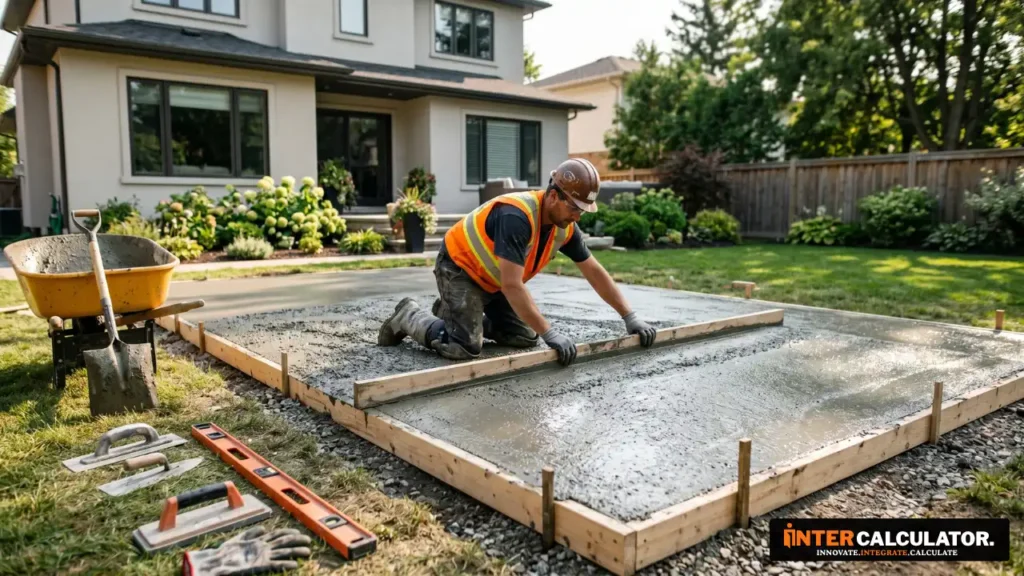
Pouring a concrete slab sounds like a big, scary job. But I promise, if you plan well and take it one step at a time, you can do this yourself. I did my first small slab for a backyard shed, and yes, I made a few mistakes, but I also saved a lot of money while learning exactly how to pour a concrete slab the right way. This guide will walk you through every step, from digging the ground to curing the finished surface.
Before you touch a single bag of concrete mix, get everything ready. Once the pour starts, there is no stopping.
Essential Tools: 2×4/2×6 lumber, stakes, hammer/screws, level, tape measure, shovel, magnesium screed, bull float.
Safety Gear: Rubber boots, heavy-duty gloves, safety glasses.
Optional (But Recommended): Rebar chairs, wire mesh, electric cement mixer (for slabs > 4×6 ft).
This depends on your location and what the slab is for. A small patio pad may not need a permit. But a foundation for a shed, garage, or any structure likely does.
Call your local building code department or check online. Also, always call 811 before you dig, this is the U.S. service that marks underground utilities for free. Skipping this step can cost you far more than the whole project.
Choose a spot that is fairly level and slightly higher than the surrounding ground. This keeps water from pooling on or around your slab. If your site slopes, you may need to grade the soil so it drains away from the slab on all sides, at least 10 feet out.
Use mason’s line or twine tied to corner stakes to outline the area. This gives you a clear picture of where everything will sit before you dig a single inch.
Pro Tip: Don’t do the math by hand and risk an expensive ordering mistake. Use our Concrete Slab Calculator to get exact bag counts, including a 10% waste factor and rebar requirements.
Always add 10% extra for spillage and uneven depth. If you’re mixing bags by hand, check the bag label, an 80-pound bag yields about 0.6 cubic feet. Use a concrete slab calculator online to double-check your numbers before you buy anything.
| Slab Size (at 4″ depth) | Cubic Feet Needed | Cubic Yards Needed | 80lb Bags Needed |
| 4′ x 4′ | 5.3 cu ft | 0.20 cu yd | 9 Bags |
| 8′ x 8′ | 21.3 cu ft | 0.79 cu yd | 36 Bags |
| 10′ x 10′ | 33.3 cu ft | 1.23 cu yd | 56 Bags |
| 12′ x 12′ | 48.0 cu ft | 1.78 cu yd | 80 Bags |
I once skipped this step, or at least rushed it. Big mistake. The depth you dig matters a lot for how long your slab lasts.
Clear the Area: Remove grass, roots, and large rocks.
Excavate: Dig 6-8 inches deep to allow for both base and concrete.
Level the Soil: Ensure the subgrade is flat before adding gravel.
Pour in your gravel (also called paver base or all-purpose gravel) and spread it evenly. Then compact it with a hand tamper in layers. Build up to a 4 to 6 inch bed, compacting each layer before adding more.
Note: Just like the concrete itself, your gravel base is usually sold by the cubic yard. You can use our Cubic Yard Calculator to figure out exactly how much crushed stone or paver base you need to order for this sub-layer.
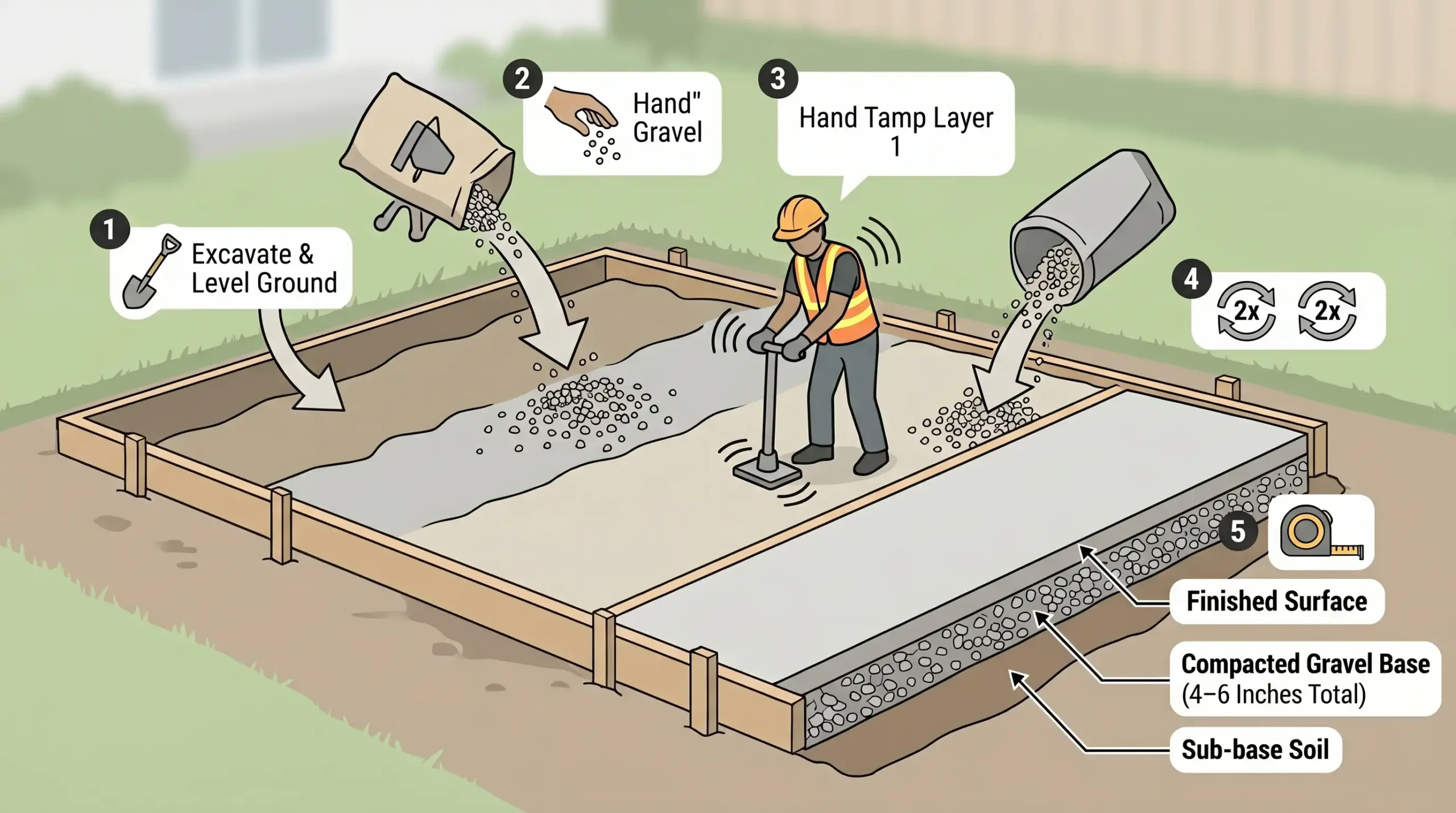
This gravel base does two things: it improves drainage and stops the slab from sinking or cracking over time. According to the Portland Cement Association (PCA), a properly compacted sub-base is one of the biggest factors in long-term slab performance.
Your form is basically a wooden mold that holds the wet concrete in shape. Use 2×4 lumber for a 4-inch slab or 2×6 lumber for a 6-inch slab. A 2×4 is actually only 3.5 inches tall, so you may need to slightly raise the boards or add a little dirt underneath to reach the right height.
Use screws instead of nails when assembling the form. This makes it much easier to take apart later without damaging your freshly cured slab. My friend learned that lesson the hard way, prying nailed boards off a new slab is not fun.
| Project Type | Slab Thickness | Lumber Size | Best Support |
| Walkway / Patio | 4 Inches | 2×4 Lumber | Wire Mesh |
| Shed / Hot Tub | 6 Inches | 2×6 Lumber | Rebar (#3 or #4) |
| Heavy Vehicle Driveway | 6-8 Inches | 2×8 Lumber | Rebar (#4 Grid) |
Set your form in place and check it with a level, both side-to-side and front-to-back. For most outdoor slabs, you actually want a very slight slope (about 1/8 inch per foot) so rainwater drains off the surface.
Drive stakes into the ground every 2 feet along the outside of the form. Nail or screw the stakes directly to the boards to hold the form firm. The concrete puts a lot of pressure on those boards when you pour, a loose form means a messy, uneven slab.
For a small patio pad or garden path, wire mesh or fibermesh added to the mix is usually enough. But for a garage floor, shed foundation, or any slab that will hold heavy loads, you really want rebar.
Think of rebar as the skeleton inside your slab. Without it, concrete under stress will crack and break apart. With it, the slab holds together even when cracks form.
Cut rebar to fit and lay it in a grid pattern, typically 4 feet on center (meaning pieces spaced 4 ft apart). Overlap any joints by at least 6 inches and tie them together with tie wire. Rest the rebar on small rebar chairs or rocks to keep it about 2 inches up from the bottom of the form. You want it sitting in the middle of the slab, not lying on the ground.
Slump is a way to measure how wet or dry the concrete mix is. For most DIY slabs, a 5 to 6 inch slump is ideal. This mix is easy to work with but not so wet that it weakens the slab.
If you are ordering from a ready-mix concrete truck, ask the driver to bring it at that slump. If you are mixing bags yourself in a wheelbarrow, add water slowly, put in the dry mix first, make a small hole in the middle, and add about ¾ of the recommended water. Mix it, check the consistency, then add more water only if needed. A drier mix makes a stronger, more crack-resistant slab.
Start pouring from one end and work toward the other. Use a shovel or concrete rake to spread the mix evenly across the form. Don’t dump it all in one spot, distribute it as you go.
Pour the concrete in sections, spreading it by moving the chute back and forth and filling the form slightly higher than the top of the boards.This way you have a little extra to screed off. If you are mixing bags, work in batches and keep the pace steady, some mixes set within 10 minutes, so a good rule of thumb is to never let more than 65% of the set time pass before you start leveling.
Grab a long, straight 2×4 board, long enough to rest on both sides of the form. Place it at one end of the slab and drag it across in a back-and-forth sawing motion. This levels the concrete to the top of the form and fills any low spots.
Work in sections. Pull the screed slowly and steadily. If there are holes left behind, add a little concrete and screed again. The goal is a flat, even surface, not perfectly smooth yet, just level.
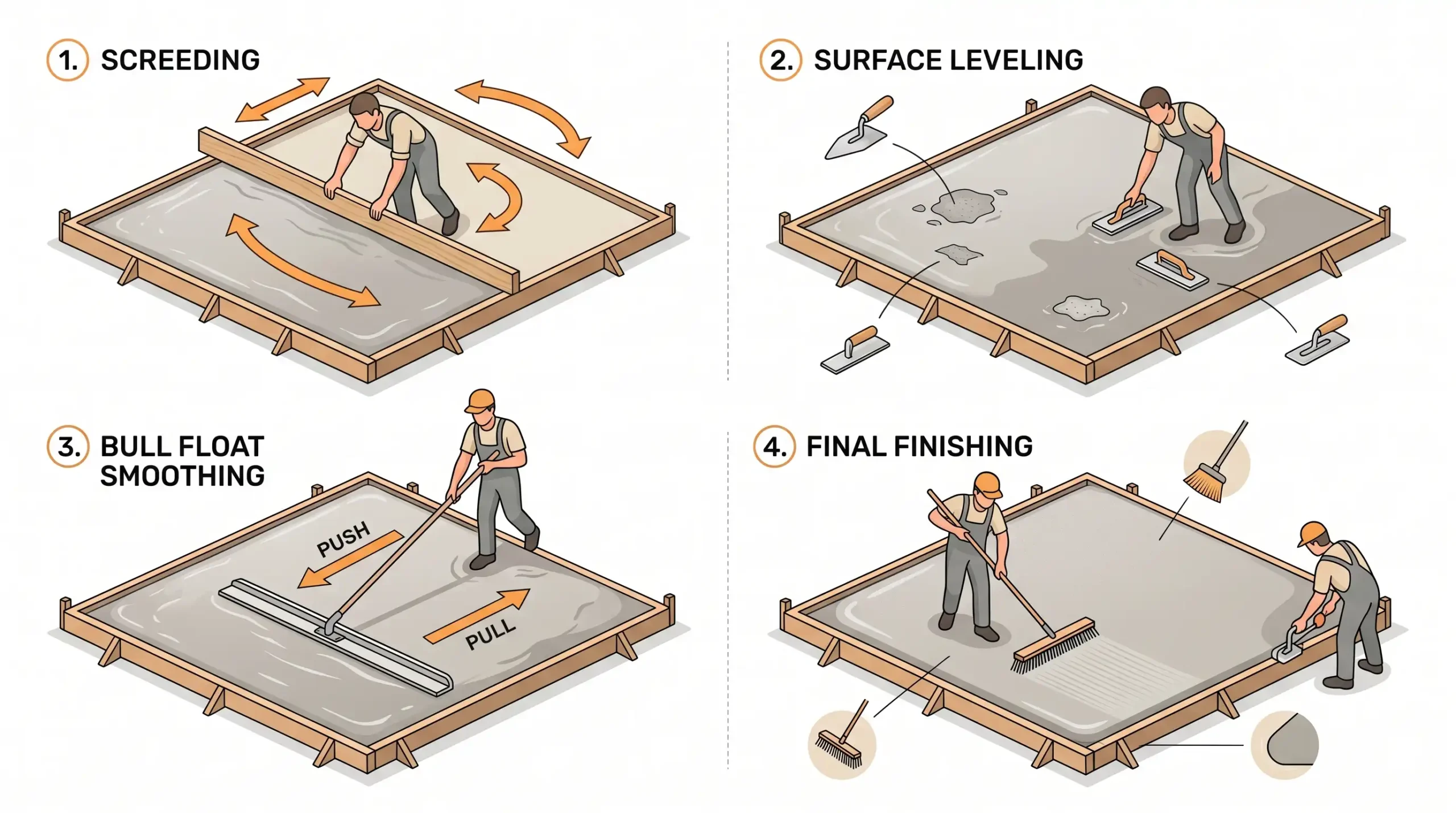
Right after screeding, use a bull float to smooth the surface. Push it forward with the leading edge slightly raised, then pull it back with the trailing edge slightly raised. This brings the fine cream or paste up to the surface and pushes the stones down.
Be careful not to over-work the surface, too many passes with a float can bring too much water up, which weakens the slab and raises the chance of cracking.
Once the surface bleed water has evaporated and the concrete feels thumbprint hard, you can do your final finishing. Run a stiff broom across the surface to create a non-slip texture, and finish the edges with a concrete edger for clean, rounded corners.
Most people think the job is done once the concrete is smooth. It’s not. Curing is when the concrete actually gains its full strength, and it takes time.
Properly cured concrete can be up to twice as strong as concrete that was not cured, and it will have a significantly longer lifespan. According to the U.S. Federal Highway Administration, concrete needs to stay moist for at least 7 days to reach most of its design strength.
Spray the surface with a concrete cure and seal product using a pump sprayer, this locks moisture inside the slab. Then cover it with wet burlap or plastic sheeting and keep it damp. Hose it down several times a day, or set up a sprinkler nearby.
Do this for at least 5 to 7 days. On hot or sunny days, the slab dries out faster, so check more often. Don’t walk on the slab for at least 24 hours, and wait at least 7 days before placing anything heavy on it.
Pouring a concrete slab yourself is totally doable. It takes planning, the right tools, and a bit of patience, but the result is something solid that will last for decades. Just remember: dig deep enough, compact your gravel base, build a strong form, and never skip the curing step. Take your time, and you’ll be proud of what you built.

For a standard 10x10 foot slab that is 4 inches thick, you will need approximately 56 bags of 80lb concrete mix. This includes a 10% waste factor for spillage. Because manual math can lead to expensive mistakes, we recommend using our [Concrete Slab Calculator] to get an exact count based on your specific dimensions.
Yes. Skipping the gravel base is one of the most common DIY mistakes. A 4 to 6-inch compacted gravel layer provides essential drainage and prevents the ground from shifting, which stops your slab from sinking or cracking over time. To estimate how much base material to buy, check our Cubic Yard Calculator.
You can typically walk on a new slab 24 hours after the pour, provided you are careful. However, you should wait at least 7 days before placing heavy furniture or equipment on it, and a full 28 days before driving a vehicle on it. Continuous curing (keeping it moist) during the first week is critical for reaching maximum strength.
Use wire mesh for light-duty projects like garden paths or small decorative patios. For anything that will hold weight, such as a backyard shed, a hot tub, or a driveway, you must use rebar. Rebar acts as the "skeleton" of the slab, providing the structural integrity needed to handle heavy loads without snapping.
For most DIY projects, aim for a 5 to 6-inch slump. In simple terms, this means the wet concrete should be consistency of thick oatmeal,malleable enough to spread easily with a rake, but not so watery that it runs like soup. A mix that is too wet is significantly weaker once cured and is much more likely to develop surface cracks.