
Ever feel stuck trying to build the “perfect” character in Dungeons & Dragons? It can be confusing to balance all those ability scores without going overboard.
That’s exactly where a point buy calculator comes in handy. It’s a simple tool that helps you assign points wisely and build a strong character, without breaking the rules.
Whether you’re a new player or a seasoned DM, understanding how point buy works will give you way more control over your stats and your story. I’ll walk you through it in the easiest way possible, just like I do when helping my own group build their characters from scratch.
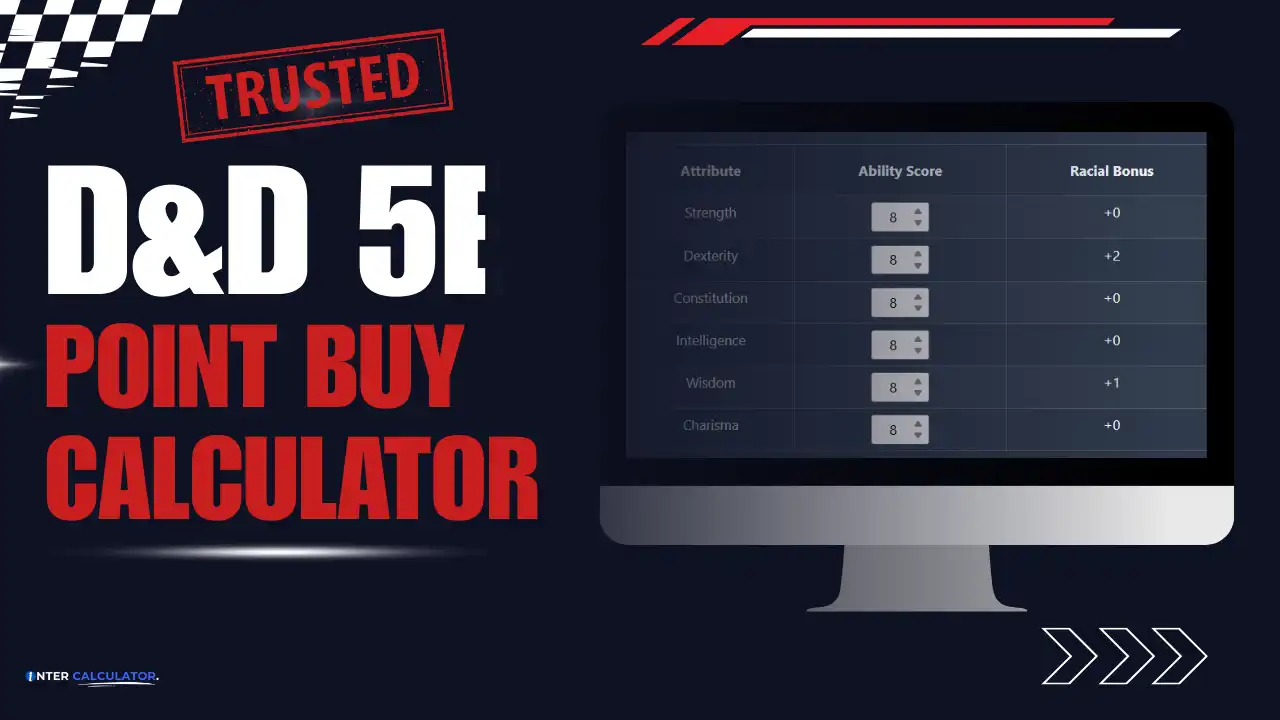
How to Use Our Point Buy Calculator (Step-by-Step)
Let’s make this easy. I’ll walk you through how to use our point buy calculator like you’re sitting right next to me at the table. It’s quick, simple, and you’ll see your character’s stats shape up in real time.
- Choose a Race
Start by picking a race from the dropdown list. The calculator will automatically add racial bonuses and traits based on your selection. No need to calculate those manually, it’s all handled for you.
- Set Ability Scores
Next, adjust your six main stats: Strength, Dexterity, Constitution, Intelligence, Wisdom, and Charisma. You can type the numbers in directly or use the little arrows to fine-tune them. - Check Your Points
You get a total of 27 points to spend; that’s the standard rule in D&D 5e. As you build your stats, the calculator shows how many points you’ve used and how many are left. - View Totals Instantly
The table updates in real time. You’ll see each stat’s base score, racial bonus, total score, modifier, and how many points each one costs you. - Reset Anytime
Want to start over? Just click Reset, and it brings everything back to the default. - Use Custom Rules (Optional)
If your DM allows house rules, switch to the Custom Rules tab. You can change the total points available, set new min or max scores, or tweak how much each score costs. Click Apply Custom Rules to lock in your new setup. - Rules Reference Tab
Need a refresher? The Rules as Written tab gives you the official D&D 5e point buy chart, so you can quickly double-check how things work. - Save Your Scores
Click Save Scores to keep your build. It saves locally in your browser, so you won’t lose your setup if you come back later.
Once you’ve set your ability scores, the calculator automatically shows the modifier for each stat (rounded down as per D&D rules). If you want to understand rounding in more detail, you can also check our Significant Figures Calculator for quick practice with rounding concepts.
How the Point Buy System Works in D&D 5e
Building a balanced character in D&D 5e can feel like a puzzle, and the point buy system gives you all the pieces. Instead of rolling dice or using a preset stat line, you get 27 points to “buy” your ability scores one by one. It’s like shopping for the perfect build.
Each score from 8 to 15 has a cost. The lower scores cost less, while higher ones take up more of your total points. For example:
- An 8 costs 0 points
- A 13 costs 5 points
- A 15 costs 9 points
You can’t go below 8 or above 15 using point buy; that’s the rule. But later, your chosen race might give a racial bonus, which could push your stats higher (like +2 to Constitution or +1 to Wisdom).
This system keeps things fair and gives every player equal control. I use point buy whenever I want to build a character that feels smart and planned out, no lucky rolls, just solid choices.
Official Point Buy Rules and Score Cost Table
If you’re using the standard D&D 5e rules, the point buy system gives you 27 points to spend across your six ability scores: Strength, Dexterity, Constitution, Intelligence, Wisdom, and Charisma.
Here’s how it works:
- Every ability starts at a base of 8
- You can increase each stat up to 15 using your 27 points
- Each increase has a point cost based on how high you go
Here’s the official cost table used in most campaigns:
| Ability Score | Point Cost |
| 8 | 0 |
| 9 | 1 |
| 10 | 2 |
| 11 | 3 |
| 12 | 4 |
| 13 | 5 |
| 14 | 7 |
| 15 | 9 |
You can’t go higher than 15 with point buy, even if you have points left. Racial bonuses come after you assign these base stats, so don’t worry if you want to hit a 16 or 17 later.
When I DM for new players, I always recommend point buy. It keeps characters balanced and avoids fights over lucky (or unlucky) dice rolls.
How Do I Calculate DnD Ability Score Modifiers?
This part confused me when I first started playing D&D, but once you get it, it sticks forever. Your ability score modifier is the number that affects your dice rolls in the game. It’s used for attacks, skill checks, saving throws, and more.
Here’s the simple rule:
👉 Take your ability score, subtract 10, then divide by 2 (and round down).
Let me show you with a few examples:
- A score of 10 or 11 gives you a modifier of +0
- A 14 gives you +2
- A 7 gives you –2
To make it easier, here’s a quick table:
| Score | Modifier |
| 1 | –5 |
| 2–3 | –4 |
| 4–5 | –3 |
| 6–7 | –2 |
| 8–9 | –1 |
| 10–11 | 0 |
| 12–13 | 1 |
| 14–15 | 2 |
| 16–17 | 3 |
| 18–19 | 4 |
| 20–21 | 5 |
I always keep this table open when building characters. It helps you quickly see how your Strength or Wisdom actually affects your rolls during the game.
Base Scores vs Final Scores (With Racial Bonuses)
Here’s where things get interesting, and honestly, where I see a lot of new players get tripped up. In D&D 5e, the numbers you choose in point buy are your base scores. But once you pick a race, those numbers often go up, thanks to racial bonuses.
Let me give you a simple example:
Let’s say you assign 15 Dexterity using the point buy system. If you pick Elf, who gets +2 Dexterity, your final score becomes 17. You didn’t “buy” a 17; your race gave it to you.
Here’s how the math works:
| Stat | Base Score (Point Buy) | Racial Bonus | Final Score |
| Dexterity | 15 | +2 (Elf) | 17 |
| Constitution | 13 | +1 (Elf Variant) | 14 |
This step happens after you’ve spent your 27 points. You can’t use point buy to go over 15, but racial bonuses can push you beyond that.
I once built a variant human paladin with base 15 Strength and +1 from the race; that little boost helped me hit harder right from level 1. Those small bonuses can really change how your character plays.
So don’t forget: Base scores are what you buy. Final scores are what you play with.
Point Buy vs Standard Array vs Rolling
There’s more than one way to set your stats in D&D 5e, and each method has its own vibe. Let’s break down the big three: Point Buy, Standard Array, and Rolling, so you can pick what fits your style (or your DM’s rules).
Point Buy
You get 27 points to build your stats however you like (between 8 and 15). Every score costs points, and higher ones cost more.
- Pros: Fair, flexible, great for balance
- Cons: Can feel “samey” if everyone min-maxes
This is what I use when I want full control. It’s perfect for building focused characters like a high-DEX rogue or a high-WIS cleric.
Standard Array
Here’s the preset list of scores you assign in any order: 15, 14, 13, 12, 10, 8
- Pros: Fast and easy, everyone’s on equal footing
- Cons: Less freedom to customize
I often recommend this for first-time players; it’s straightforward, no math needed, and keeps the game moving.
Rolling (4d6 drop lowest)
You roll four six-sided dice for each stat, drop the lowest, and add the rest.
According to data shared by the RPG community, this method gives you an average ability score of about 12.24, which is notably higher than standard array or point buy builds.
- Pros: Can lead to powerful (or very weak) characters
- Cons: Risky, and often creates an imbalance between players
One of my friends rolled three 18s once… and another rolled a bunch of 9s. Guess who had more fun?
So, which one should you use?
- Want control? Go with Point Buy
- Want simplicity? Try Standard Array
- Want chaos? Roll the dice and hope for the best!
At the end of the day, it depends on your group’s play style, but personally, I stick with point buy for most of my campaigns. It keeps things fair and helps every character shine.
5 Common Mistakes When Using Point Buy
Even though the point buy system is meant to keep things simple and fair, it’s easy to mess up if you’re not careful. I’ve made a few of these mistakes myself, especially when I first started creating characters.
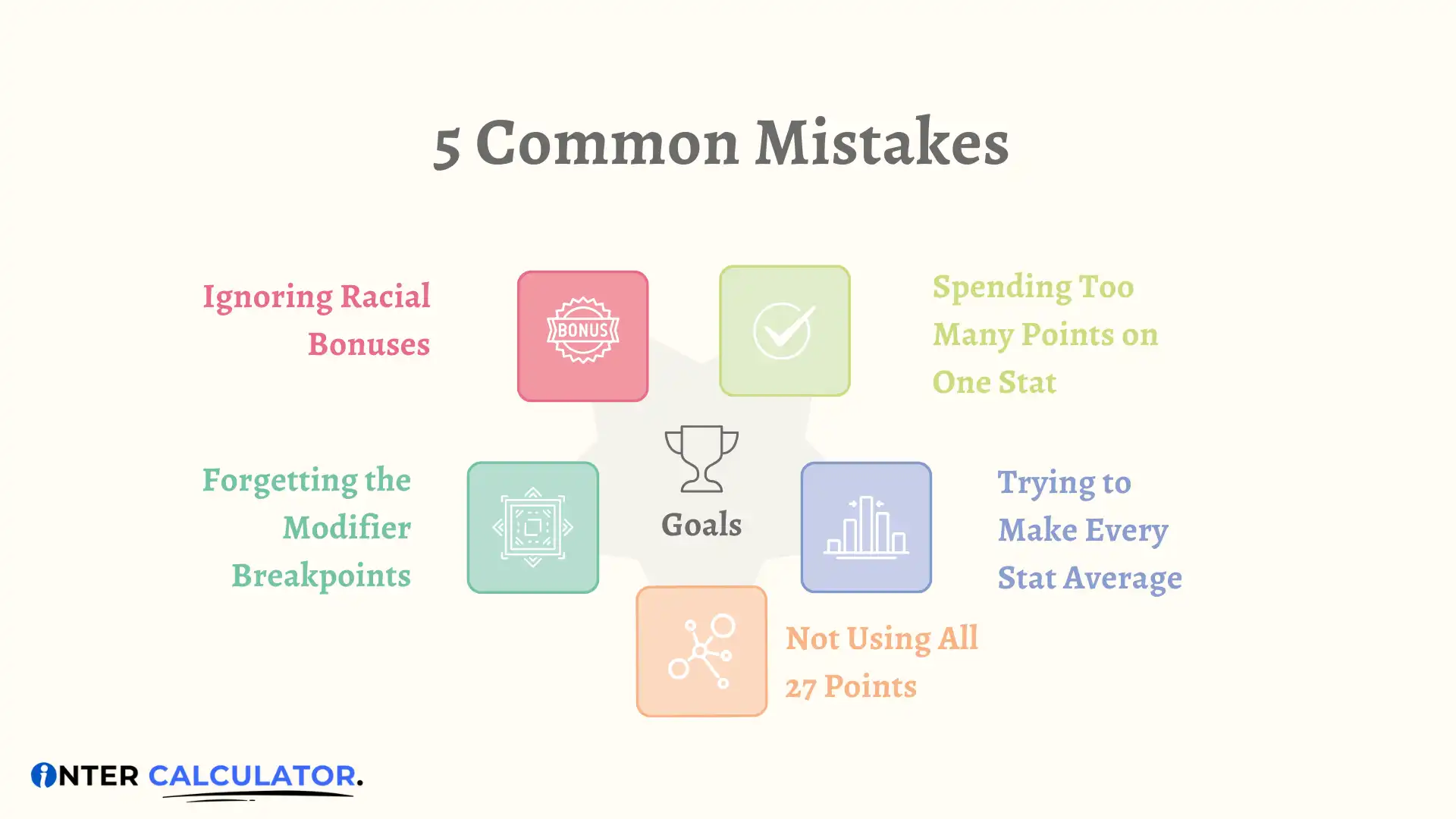
Let’s go over the most common slip-ups so you can avoid them:
-
Spending Too Many Points on One Stat
It’s tempting to pump one ability, like Strength or Charisma, all the way up to 15, especially for classes like barbarians or bards. But remember, 15 costs 9 points, and that’s a big chunk of your 27. You’ll often end up with weak stats everywhere else.
-
Ignoring Racial Bonuses
A lot of players forget that racial bonuses apply after point buy. If you’re playing a race that gives +2 to Intelligence, you might not need to buy a full 15; starting at 13 or 14 might be smarter.
I once built a tiefling warlock and wasted points pushing Charisma to 15, even though I got +2 from the race. Could’ve used those points elsewhere.
-
Trying to Make Every Stat Average
Some people aim for balance, putting all scores around 12 or 13. While that feels “safe,” it often leads to characters that don’t really shine in anything. Focus on what your class needs most.
-
Forgetting the Modifier Breakpoints
Modifiers increase every 2 points, so going from a 13 to a 14 gives you a +2 instead of +1. But jumping from 14 to 15? Still +2, you just spent 2 points for no modifier gain. Ouch.
-
Not Using All 27 Points
Sometimes people stop early or don’t realize they have points left. The calculator helps track this, but double-check before saving your build.
Point buy gives you structure, but it still takes some thinking to use it well. Once you get the hang of it, you’ll build characters that feel strong and well-rounded without wasting a single point.
Why We Built This Calculator
We built this point buy calculator because we’ve been in your shoes, flipping through books, doing math on paper, and second-guessing every stat decision. It slowed down our character creation, and honestly, it took some of the fun out of it.
So we made something better. A tool that’s easy to use, clear to understand, and actually helpful, whether you’re brand new to D&D 5e or helping your entire party get set up before session one.
I remember one time before a game night, my friend was stressing over how to balance his wizard’s Intelligence and Dexterity. We sat down with this tool, plugged in his ideas, and within minutes, he had a build he loved, no confusion, no wasted points.
This calculator takes the guesswork out of point buy and puts you in control, with clean totals, automatic racial bonuses, and even custom rules if your DM likes to mix things up.
It’s built by players, for players, to make character creation feel smooth, fair, and actually fun.
Final Thoughts
Point buy isn’t just about numbers; it’s about giving you the freedom to shape your character exactly how you want. Whether you’re building a clever rogue, a sturdy fighter, or a charming bard, this system lets you plan with purpose and avoid the randomness of dice rolls.
I’ve used point buy for most of my characters, and honestly, it’s helped me stay focused on who I want them to be, both in stats and in story. It might feel a bit technical at first, but once you get the hang of it, it becomes second nature.
If you’ve got questions, thoughts, or want help building your next hero, drop them in the comments. I’d love to hear how you use point buy in your own games.
Just like point buy helps you balance your character’s abilities, some tools help balance scores in other areas of life. For example, our AP Lang Calculator lets students estimate their exam scores quickly and easily.
Frequently Asked Questions
What is a Point Buy Calculator?
A Point Buy Calculator helps players create balanced characters by assigning ability scores within a fixed point budget. It ensures your stats follow official game rules without manual math.
How does the point buy system work in D&D 5e?
In 5e, each ability score starts at a base value, and you spend points to increase them. Higher scores cost more points, which prevents overpowered characters and keeps the game fair.
Why should I use a Point Buy Calculator instead of rolling dice?
Point buy gives players more control and balance in character creation. Unlike dice rolls, it avoids extremes where one character is much stronger or weaker than others.
Can the calculator be used for different RPG systems?
Yes, but it depends on the calculator. Some are built specifically for D&D 5e, while others allow customization for Pathfinder or homebrew systems that use similar point buy rules.
Does the calculator apply racial or background bonuses?
This calculator was created by the InterCalculator Editorial Team, led by Haris Farooq (Formula & Development). Our team specializes in formula research, calculator logic, and technical development, ensuring each tool is accurate, fast, and easy to use.
View Team →Before publishing, every calculator goes through the InterCalculator Accuracy Review Process. For the D&D Point Buy Calculator, we verify formulas against official D&D 5e rules and player-tested standards. We test the calculator with a wide range of character builds, including unusual stat arrays and custom rule sets. All calculations are reviewed with an experienced tabletop gaming expert to confirm accuracy, clarity, and reliability.
View Process →