
You know what? Managing a team gets tricky when some people work 40 hours and others do just 15 or 20. I’ve been there myself.
That’s where FTE (or full-time equivalent) comes in. It’s a simple way to measure your workforce capacity by turning all those different working hours into one clear number. Think of it like converting different currencies into dollars; suddenly, everything makes sense.
Use the calculator below to find your FTE in seconds. No complicated math. No confusion. Just quick answers that help you make smart staffing decisions, plan your budget better, and stay on top of compliance rules. Whether you’re an HR manager or a business owner, this tool saves you time and keeps things accurate.

What Is Full-Time Equivalent (FTE)?
Full-time equivalent is just a smart way to measure how much work your team actually does. It converts all your employees’ hours, whether they’re full-time or part-time, into one standard number.
Here’s a simple example. Let’s say you have two part-time workers who each work 20 hours per week. Together, they equal 1.0 FTE. That’s the same as one person working a full 40-hour week.
Why does this matter? Well, it helps you compare apples to apples. You can measure your workforce capacity fairly, no matter if someone works 10 hours or 40. It makes budgeting, planning, and reporting so much easier.
How to Calculate FTE (Formula & Examples)
Let me be honest, the first time I tried calculating FTE manually, I made a mess of it. I mixed up weekly and annual hours, and my numbers were all over the place. But once I learned the simple formula, everything clicked.
FTE Formula
The basic FTE formula is super easy. You take the total hours worked by everyone and divide them by your standard full-time hours. That’s it.
For weekly calculations: Total weekly hours ÷ 40 = FTE
For annual calculations: Total annual hours ÷ 2,080 = FTE (that’s 40 hours × 52 weeks)
The calculator above does this math for you automatically. It converts everything to weekly hours first, then gives you the final number.
Step-by-Step Calculation
Here’s how to do it yourself if you want to calculate FTE by hand.
Step 1: Figure out your standard full-time hours. Most companies use 40 hours per week or 2,080 hours per year. Some use 35 or 37.5, so check your policy first.
Step 2: Add up all the hours your employees work. Include both full-time and part-time workers. Don’t leave anyone out.
Step 3: Now divide that total by your standard hours. So if everyone worked 500 hours total in a week, you’d do 500 ÷ 40 = 12.5.
Step 4: The answer is your FTE count. In this case, you have 12.5 full-time equivalents on your team.
FTE Calculation Example
Let me walk you through a real calculation so you can see exactly how this works in practice.
Imagine you own a restaurant. You have 10 full-time employees who work 40 hours per week, your cooks, servers, and shift managers. You also have 5 part-time workers doing 20 hours each, maybe students who work evenings and weekends.
Here’s the math: Start with your full-time staff. That’s 10 × 40 = 400 hours per week.
Now your part-time team: 5 × 20 = 100 hours per week.
Add both together: 400 + 100 = 500 total hours.
Finally, divide by the standard 40-hour work week: 500 ÷ 40 = 12.5 FTE.
So what does that mean? Even though you have 15 people on your payroll, your actual workforce capacity is 12.5 full-time equivalents. That’s the number you’d report for things like ACA compliance or when planning your labor costs for next quarter.
The funny part is, most business owners I know just count heads and wonder why their budget never adds up right. But once you think in FTE, everything makes way more sense.
Why Calculate FTE? (Key Benefits)
I’ll be straight with you, knowing your FTE isn’t just about paperwork. It actually helps you run your business better in ways you might not expect.
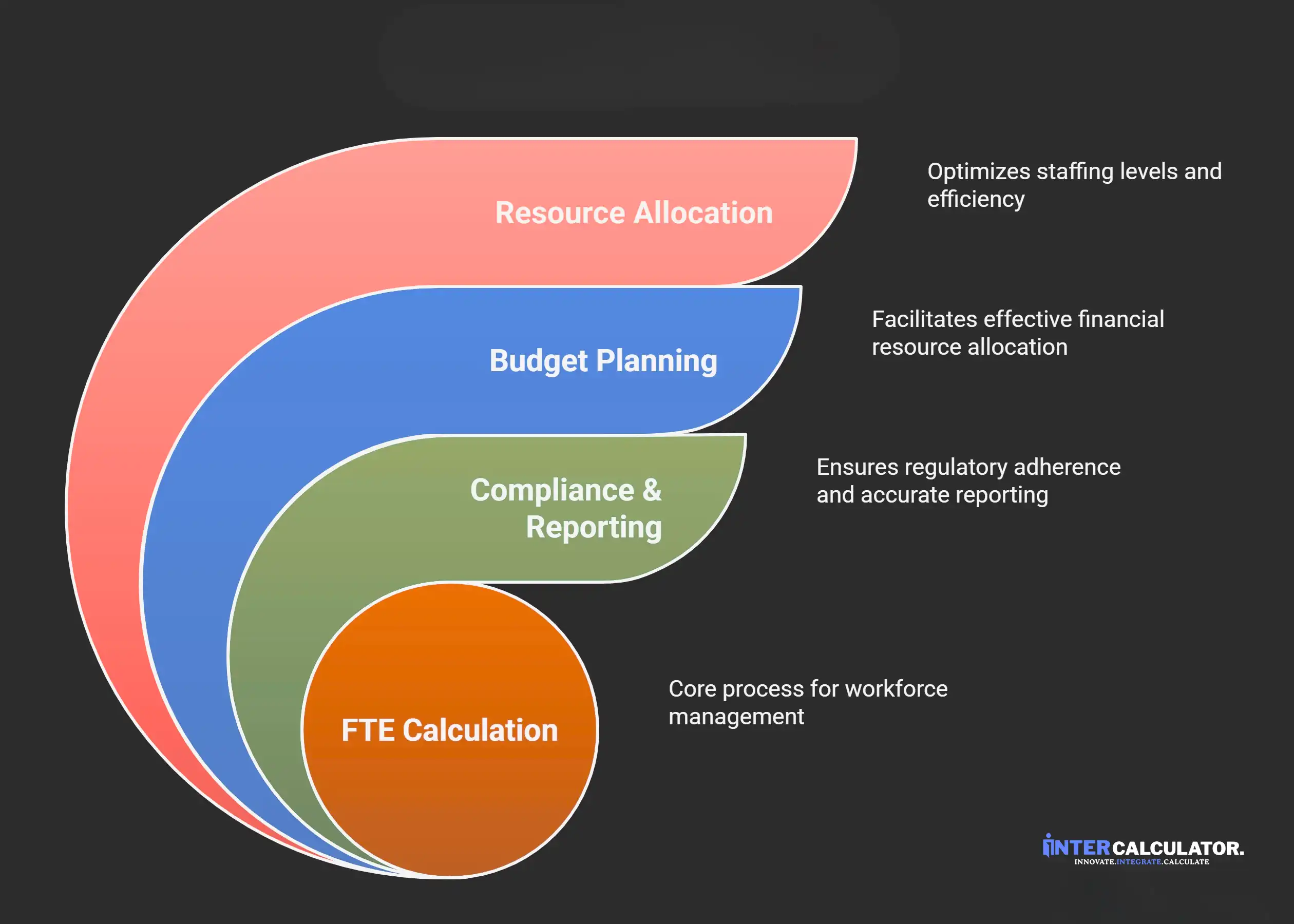
Compliance & Reporting
If you hit 50 or more FTE, the ACA says you must offer health insurance to your team. Drop below 25 FTE? You might qualify for small business tax credits.
According to the U.S. Internal Revenue Service (IRS), employers must calculate FTEs accurately to determine eligibility for the Small Business Health Care Tax Credit and to stay compliant with ACA coverage rules.
Getting these numbers wrong can cost you thousands in penalties or missed savings.
Budget Planning
When I helped a friend plan his payroll last year, we used FTE to forecast his labor costs for six months. Way more accurate than just counting people. You can see exactly what your workforce actually costs, not just how many names are on the list.
If you’re planning ahead financially, you can use our free Future Value Calculator. It helps you project how your savings or investments will grow over time, perfect for long-term budgeting.
Resource Allocation
Need to staff a new project? FTE shows if you have the capacity or if you need to hire. It’s like checking your gas tank before a road trip, you know if you’ll make it or need to refuel.
Performance Analysis: Compare productivity across teams fairly. A department with 8.5 FTE producing the same output as one with 12 FTE? Now you know which team’s working smarter.
Common FTE Percentages Explained
You’ll see FTE numbers thrown around a lot, so here’s a quick guide to what they actually mean in real hours.
- 1.0 FTE = 40 hours per week (100%) – That’s your standard full-time employee
- 0.75 FTE = 30 hours per week (75%) – Common for part-time positions with benefits
- 0.5 FTE = 20 hours per week (50%) – Half-time, like someone working mornings only
- 0.25 FTE = 10 hours per week (25%) – Weekend shifts or very part-time workers
Think of it this way: the decimal tells you what fraction of a full week someone works. A 0.8 FTE? They’re working 80% of full-time, which is 32 hours. Simple math that makes comparing employees super easy.
Why We Built This FTE Calculator
Last year, I got a call from my cousin Sarah. She runs a small bakery in Oregon with about 20 people on her team, some working full days, others just mornings or weekends.
She was freaking out. Tax season was coming, and she had no idea if she qualified for the small business health care tax credit. She’d been counting heads all wrong. “Do I have 25 employees or not?” she asked. “I can’t afford to mess this up.”
I tried explaining FTE over the phone. She grabbed a pen, scribbled numbers on a napkin, got confused, and nearly gave up. That’s when it hit me; this shouldn’t have been so hard.
So we built this calculator at InterCalculator. Not for accountants or HR experts. Business owners who are already juggling a million things and don’t have time to figure out whether 15 part-time workers equal 7.5 or 8.2 FTE.
Running a small business means keeping an eye on every dollar, from payroll to profits. That’s why tools like our Dividend Calculator come in handy for investors or business owners who want to track potential returns alongside daily operations.
We wanted something simple. Something that just works. You punch in your numbers, and boom, you get your answer. No spreadsheets. No second-guessing.
Because honestly? Running a business is tough enough. You shouldn’t need a math degree to know if you’re hiring the right number of people or if you’re about to trigger some compliance rule you’ve never heard of.
We’ve seen too many small companies get blindsided by ACA penalties or miss out on tax credits they qualified for, all because the math felt too complicated. That’s not right.
So yeah, that’s why we made this tool for Sarah and every other business owner who just needs a straight answer without the headache.
Final Thoughts
Look, calculating FTE doesn’t have to be complicated. Whether you’re trying to stay compliant with the ACA, plan your budget for next quarter, or just figure out if you need to hire more people, this calculator gives you the answer in seconds. I’ve seen too many business owners stress over spreadsheets when they could’ve just plugged in their numbers and moved on.
Use the tool above, save yourself the headache, and spend that time actually running your business. And hey, if this helped you out, I’d love to hear about it. Drop a comment or share it with another small business owner who might need it. We’re all figuring this stuff out together.
And if you’re managing investments on the side, our Stock Average Calculator helps you keep your portfolio balanced and your costs clear, just like how FTE keeps your staffing numbers accurate.
Frequently Asked Questions
Does FTE include paid time off?
Yes, it does. When you’re calculating FTE, you count PTO as part of an employee’s scheduled hours. So if someone works 40 hours per week and takes a vacation day, they’re still a 1.0 FTE. The calculation looks at their regular schedule, not just the days they’re physically in the office.
What’s the difference between FTE and headcount?
Headcount just counts warm bodies, how many people you employ. FTE measures actual work hours. So 10 people on your team? That’s a headcount of 10. But if half of them are part-time, your FTE might only be 7.5. I’ve seen HR managers make big mistakes by confusing these two.
How is FTE used for ACA compliance?
Here’s where it gets important. If you have 50 or more FTE, the Affordable Care Act says you must offer health insurance to full-time employees. Miss this, and you face penalties. The IRS checks your FTE count, not just how many people work for you.
Do contractors count toward FTE?
No, they don’t. Independent contractors (those 1099 workers) aren’t included in your FTE calculations. Only W-2 employees count. This is actually good news if you’re trying to stay under that 50 FTE threshold for ACA compliance.
Why is calculating FTE important for businesses?
Calculating FTE (Full-Time Equivalent) helps businesses understand total workforce capacity, plan staffing needs, manage budgets, and make informed decisions about productivity and resource allocation.
This calculator was created by the InterCalculator Editorial Team, led by Haris Farooq (Formula & Development). Our team specializes in formula research, calculator logic, and technical development, ensuring each tool is accurate, fast, and easy to use.
View Team →Before publishing, every calculator goes through the InterCalculator Accuracy Review Process. We verify formulas against trusted sources for the FTE Calculator to ensure full-time and part-time hour conversions align with standard HR benchmarks. We test results across multiple scenarios with experienced HR and compliance experts to confirm accuracy and reliability.
View Process →