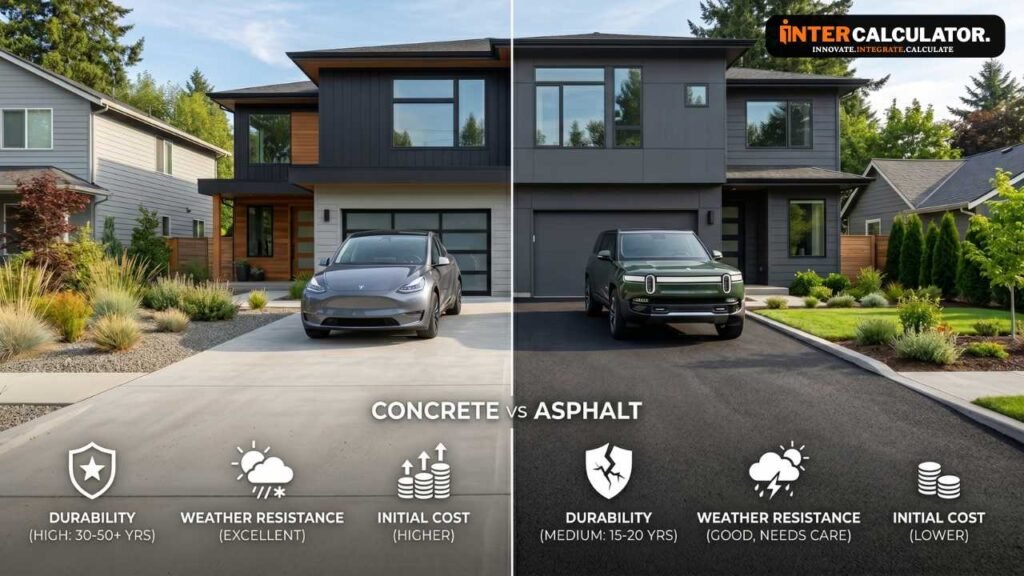
You’re standing in your driveway, staring at a bunch of cracks, and thinking , okay, it’s time to replace this thing. But then comes the big question: do you go with concrete or asphalt? Honestly, I’ve been there too, and I know how confusing it gets. Both look fine at first. Both do the job. But they are very different when it comes to cost, durability, maintenance, and how they hold up in your local climate. In this guide, I’ll break it all down in plain, simple words , so by the end, you’ll know exactly which driveway material is the right pick for your home in 2026.
At their core, these two materials are completely different , not just in looks, but in how they’re made and how they behave under your car every single day.
Concrete is a mix of cement, sand, gravel, and water. (If you’re curious about the raw materials needed for your sub-base, you can use a Gravel Calculator to get your estimates right). When you pour it and let it dry, it turns into a hard, solid slab , almost like a rock. Most contractors also add rebar (steel bars) inside to make it even stronger. That’s why a concrete driveway feels so firm and stiff under your feet. It doesn’t bend. It doesn’t flex. It just holds.
Asphalt is made from crushed stone, sand, and a thick black sticky liquid called bitumen , which comes from petroleum (basically oil). That’s what gives it that dark black color. Unlike concrete, asphalt is flexible by nature. It can bend a little without breaking, which , as you’ll see later , actually matters a lot depending on where you live.
So think of it this way: concrete is like a solid brick, and asphalt is more like a firm rubber mat. Same job, very different feel.
Let’s talk money , because this is usually the first thing people ask me about. And honestly, the answer isn’t as simple as “asphalt is cheaper.” It depends on whether you’re thinking short-term or long-term.
Right now, asphalt is the cheaper option to install. You’re looking at around $4 to $8 per square foot. For a standard 600-square-foot driveway, that’s roughly $2,400 to $4,800 total.
Concrete costs more upfront, about $6 to $12 per square foot. While these are averages, using a Concrete Cost Calculator can help you plug in your specific dimensions to see how it fits your 2026 budget. According to data from various state departments of transportation, while concrete requires a higher initial investment, it often becomes more cost-effective after the first 12–15 years due to significantly lower repair needs.
Here’s a quick side-by-side so you can see it clearly:
| Feature | Asphalt | Concrete |
| Cost per sq ft | $4 – $8 | $6 – $12 |
| 600 sq ft total | $2,400 – $4,800 | $3,600 – $7,200 |
| Install time | 1–2 days | 5–7 days |
| Ready to use | 24–48 hours | 7–10 days |
Here’s a quick side-by-side so you can see it clearly:
So yes , asphalt wins on upfront installation cost. No question there.
Here’s where things flip. And this is the part most people don’t think about when they’re getting quotes.
Asphalt needs sealcoating every 2 to 3 years , that costs around $500 to $1,000 each time. Around the 15-year mark, you’ll likely need a full resurfacing, which adds another $1,500 to $3,000. Add it all up over 30 years, and you could easily spend $8,000 to $10,000 on an asphalt driveway.
Concrete? You might seal it once every 5 to 7 years and fix the occasional crack , maybe $200 to $500 every 10 years or so. Over 30 years, your total sits around $6,500 to $8,000.
I remember a neighbor of mine who went with asphalt because it was $1,800 cheaper upfront. Ten years later, he’d already spent more than that on crack repairs and two rounds of sealcoating. He told me, “I wish someone had shown me the full picture.”
So if you’re staying in your home long-term , concrete is the smarter financial choice. If you’re on a tight budget right now, asphalt gets you started without breaking the bank.
If I had to pick one thing that separates concrete and asphalt the most , it’s how long they last. And the gap is bigger than most people expect.
A well-installed concrete driveway can last anywhere from 30 to 40 years. Some last even longer , up to 50 years , with just basic care. The Portland Cement Association says concrete can outlast asphalt by up to 50% in mild climates. That’s not a small difference.
What makes it so tough? The cement and gravel mix cures into a surface with over 4,000 PSI of strength. It handles heavy vehicles, hot summers, and everyday wear without softening or shifting. Yes, it can crack in very harsh winters if it’s not installed right , but newer concrete mixes have come a long way in handling that.
To be fair, when concrete does crack, the repair cost is higher than asphalt. But you’ll be dealing with that problem far less often.
A good asphalt driveway typically lasts 15 to 25 years. That’s still a solid run, but noticeably shorter than concrete. However, asphalt is an engineering marvel in its own right. Studies from the National Asphalt Pavement Association (NAPA) show that asphalt is the most recycled material in America, with over 90% of old pavement being reused in new roads.
The big weakness of asphalt is heat. In hot summers, the bitumen binder softens. Heavy cars or trucks can leave marks and ruts in the surface. Oil spills soak in fast and are almost impossible to clean out. Over time, UV rays from the sun dry out the surface and cause it to fade and crack.
On the flip side , and this is worth knowing , asphalt is genuinely great in cold climates. It flexes with the ground during freeze-thaw cycles instead of cracking, which is a real advantage in northern states.
Honestly, if you’re in a warm or moderate climate and you want something that just lasts and needs little attention , concrete wins this round easily. But if you’re in a colder region and okay with regular maintenance, asphalt holds its own.
Here’s the truth nobody tells you upfront , the purchase price of your driveway is just the beginning. What you spend on maintenance over the years can completely change which material was actually the better deal. Let me break it down simply.
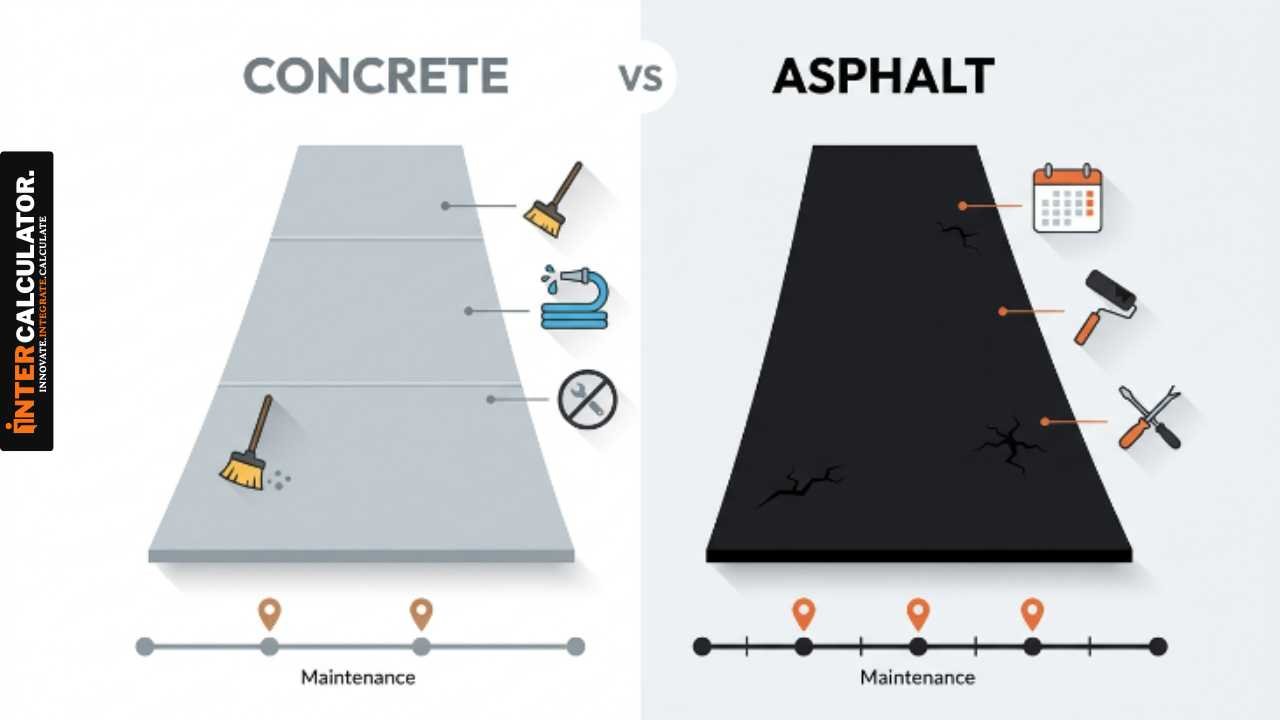
Asphalt needs more regular attention than concrete. Think of it like a car , skip the oil changes and things go wrong fast.
Here’s what a typical asphalt maintenance schedule looks like:
Sealcoating needs to happen every 2 to 3 years. This keeps the surface from drying out, fading, and cracking. Each round costs around $300 to $700 depending on your driveway size.
Crack filling should be done every year , or at least every time you spot a new crack. Small cracks let water get in. Water freezes. Freezing makes the crack bigger. Catching it early costs maybe $100 to $200. Ignoring it could mean a full resurfacing job.
Speaking of which , around the 12 to 15 year mark, most asphalt driveways need resurfacing. That’s a fresh layer over the old one, and it runs about $1,500 to $3,000 for a standard driveway.
It’s not a huge amount each time, but it adds up. And honestly, if you’re someone who forgets about home upkeep for years at a time , asphalt will show it.
Concrete is much more low-key. I’d call it the “set it and mostly forget it” option.
You only need to seal a concrete driveway every 5 to 7 years. A basic concrete sealer costs around $100 to $300 to apply , and it just adds a protective layer against water and stains.
A good pressure wash once or twice a year keeps it looking clean. Oil stains and tire marks can usually be scrubbed off with the right cleaner , unlike asphalt, where stains soak in permanently.
One big thing to watch out for: de-icing chemicals and rock salt in winter. They can slowly damage the concrete surface over time. Use sand instead when you can, or pick a concrete-safe de-icer.
When concrete does crack , and eventually it will , the repair is trickier and pricier than asphalt. Patches don’t always blend in perfectly either, which can bug people who care about looks.
But overall? Concrete demands less of your time and attention year after year. For busy homeowners who don’t want to think about their driveway every spring , that’s a big win.
This is the section I wish more people read before making their decision. Because here’s the thing , the “best” driveway material isn’t the same for everyone. It depends a lot on where you live. Your climate can make or break either material, no matter how good the installation is.
If you live somewhere like Minnesota, Wisconsin, or anywhere in the northern states , winter is rough on driveways. The ground freezes, expands, thaws, and contracts , sometimes multiple times in a single week.
Asphalt handles this really well. Because it’s naturally flexible, it moves with the ground instead of fighting it. That flexibility means fewer cracks during those brutal freeze-thaw cycles. It also helps that asphalt’s dark color absorbs heat from the sun, which speeds up snow and ice melting on cold days.
Concrete in cold climates is a different story. It’s rigid , so when the ground shifts underneath it, it’s more likely to crack. It can be done well in cold regions, but it needs very careful installation, proper expansion joints, and the right concrete mix. A rushed or cheap concrete job in a cold climate is going to show problems within a few years.
Also , and I can’t stress this enough , de-icing salts used in winter can slowly eat away at concrete surfaces. That’s another strike against concrete in snowy states.
So for cold climates? Asphalt is the safer, smarter pick.
Now flip it around. If you’re in Texas, Florida, or anywhere in the southern states , summer heat is your biggest enemy.
Asphalt really struggles in extreme heat. When temperatures climb high, the bitumen binder inside asphalt starts to soften. Park a heavy car or truck on it during a hot afternoon and you might actually see ruts and indentations left behind. In really intense heat , above around 120°F surface temperature , asphalt can go almost tacky, like soft tar. Not great.
Concrete stays completely stable in the heat. It doesn’t soften. It doesn’t deform. And because it’s a lighter color, it actually reflects sunlight instead of absorbing it , which keeps the surface cooler and also helps with the heat island effect in your neighborhood.
I talked to a contractor in Houston once who said he almost never recommends asphalt for driveways there anymore. “It just doesn’t hold up the way people expect,” he told me. After a couple of hot summers, the surface starts showing wear that should take years to appear.
For hot climates , concrete wins, and it’s not even close.
Let’s be honest , a driveway isn’t just functional. It’s one of the first things anyone sees when they pull up to your home. And if you care even a little about how your place looks, this section matters.
Concrete is basically a blank canvas. You can do so much with it.
Want it to look like cobblestone? Done. Slate? Easy. You can get it stamped into almost any pattern you like , and from the street, it genuinely looks like expensive stonework. I’ve seen stamped concrete driveways that made a simple suburban home look like something out of a magazine.
Then there’s staining. You can go warm , think rich browns and terracottas , or cool, like soft grays and blues. The color soaks into the surface and holds up really well over time. No peeling, no flaking.
If you want something sleek and modern, a polished concrete finish gives you a smooth, almost glossy look. Or go the other way with exposed aggregate , where small stones show through the surface for a natural, textured feel.
All of these options let you match your driveway to your home’s exterior, your garden, even your roof color. For curb appeal and resale value , especially in higher-end neighborhoods , a beautifully finished concrete driveway can genuinely impress buyers.
Asphalt keeps things simple. You get one look , that classic, smooth black finish. And honestly? It looks really sharp when it’s freshly laid. Clean, crisp, and modern against green grass or a light-colored home.
The problem is that without regular sealcoating, asphalt fades from black to a dull gray over time. It loses that fresh look faster than concrete does.
You can’t stamp it. You can’t stain it. There are no patterns or colors to choose from. What you see is what you get.
That said , some people actually love the simplicity. Not everyone wants a fancy driveway. If your goal is a clean, low-fuss look that just works, asphalt delivers that without any extra effort or cost.
But if you want your driveway to genuinely make a statement and add to your home’s personality , concrete is the clear winner here.
Okay, so we’ve covered a lot. Cost, durability, maintenance, climate, looks , all of it. Now let me give you my straight, honest take. No fence-sitting.
If money is tight right now , asphalt is your friend. The upfront installation cost is simply lower. You can get a solid asphalt driveway laid for significantly less than concrete, and you can start using it within a day or two.
But here’s what I always tell people: think about how long you’re staying in your home.
If you’re planning to move in the next 5 to 10 years , asphalt makes total sense. Lower cost now, someone else deals with it later.
If you’re staying put for 20, 30 years , the math flips completely. All those sealcoating rounds, crack repairs, and that mid-life resurfacing job add up fast. Over a 30-year period, a concrete driveway often ends up costing you less overall. It just hurts more at the start.
So the honest answer? Asphalt wins short-term. Concrete wins long-term. Pick based on your timeline, not just today’s price tag.
This one isn’t close in my opinion , concrete wins.
A well-maintained concrete driveway adds real curb appeal. It looks more polished, lasts longer, and tells potential buyers that the home has been cared for properly. In higher-end neighborhoods especially, a beautiful stamped concrete or exposed aggregate driveway can genuinely move the needle on your resale value.
Asphalt can look great too , especially when it’s fresh and well-sealed. But its shorter lifespan and limited design options mean it rarely impresses buyers the same way. A buyer looking at two similar homes will almost always feel better about the one with a clean, solid concrete driveway.
Here’s my overall take , and I say this having seen both up close many times:
Go with asphalt if you need to save money now, you live in a cold northern state, or you just want something simple and functional.
Go with concrete if you’re in it for the long haul, you live somewhere warm, you care about how your home looks, or you want to boost your property value.
There’s no wrong answer here , just the right answer for your situation. And now you have everything you need to make that call confidently.
| Feature | Asphalt | Concrete |
| Upfront Cost | $4–$8 per sq ft ✅ | $6–$12 per sq ft |
| 30-Year Total Cost | $8,000–$10,000 | $6,500–$8,000 ✅ |
| Lifespan | 15–25 years | 30–40 years ✅ |
| Maintenance Frequency | High (every 2–3 yrs) | Low (every 5–7 yrs) ✅ |
| Repair Cost | Low ✅ | Higher |
| Cold Climate Performance | Excellent ✅ | Average |
| Hot Climate Performance | Poor | Excellent ✅ |
| Design & Customization | Limited | Highly customizable ✅ |
| Curb Appeal | Clean, simple | Premium look ✅ |
| Resale Value Impact | Moderate | Strong ✅ |
| Eco-Friendliness | Recyclable ✅ | Permeable options ✅ |
| Installation Time | 1–2 days ✅ | 5–7 days |
| Ready to Use | 24–48 hours ✅ | 7–10 days |
✅ = Winner in that category
At a glance , concrete wins more categories overall. But if your budget is tight or your winters are brutal , asphalt is absolutely the right call for you.
At the end of the day, both concrete and asphalt do the job well. It really just comes down to your situation.
Tight budget right now? Go with asphalt. Planning to stay long-term and want something that lasts? Concrete is worth every extra dollar.
Cold climate , asphalt. Hot climate , concrete. Simple as that.
Just make sure whoever installs it is a good licensed contractor. The best material in the world won’t save a bad installation job.
Your driveway is something you see every single day. Take a little time to make the right call, and once you do, use a Concrete Calculator to finalize your measurements so you can get an accurate quote from a contractor. I promise you won’t regret doing the homework first.
Got questions about your specific situation? Drop them in the comments. I’d love to help.

A concrete driveway typically lasts 30 to 40 years with proper care. Asphalt usually lasts 15 to 25 years. Concrete simply outlasts asphalt , sometimes by decades.
Asphalt is cheaper upfront at $4 to $8 per square foot. Concrete runs $6 to $12 per square foot. But over 30 years, concrete often costs less overall thanks to lower maintenance needs.
Asphalt is better for cold climates. It's flexible, so it handles freeze-thaw cycles without cracking as easily as concrete. If you're in states like Minnesota or Wisconsin , asphalt is the safer pick.
An asphalt driveway needs sealcoating every 2 to 3 years. Skip it too many times and cracks spread fast , turning a cheap fix into a costly resurfacing job.
Yes , generally speaking. A well-maintained concrete driveway adds stronger curb appeal and impresses buyers more, especially in higher-end