
Last Updated: 11-06-2025

Discount calculator

Shop Smarter, Save Bigger

Table of Contents

Ever spotted a big “50% Off” tag and want to know how much you’ll really pay? That’s where a discount calculator helps. It takes away the guesswork and does the math for you. Whether it’s a sale, a coupon, or a special percent-off deal, this tool quickly shows your final price and how much you save. Knowing your real savings helps you shop smarter and make better choices.

free discount calculator

What Is a Discount Calculator?

A discount calculator is a simple tool that helps you instantly figure out the final price after applying a percentage or fixed amount discount. It takes the original price, subtracts the discount value, and shows how much you’ll save and what you’ll actually pay. From quick retail markdowns to more complex offers, it cuts through the math so you can shop smarter with confidence.

How to Use a Discount Calculator: Step-by-Step

Using a discount calculator is as easy as entering a few values and hitting one button. Here’s how to do it:

  1. Enter the original price – Start by typing the product’s price before discount. In this example, it’s $59.99.

  2. Add the discount – Enter either a percentage (like 15%) or a fixed amount you’re saving.

  3. Select the discount type – Choose between “Percent off” or “Fixed amount off” depending on your deal.

  4. Click Calculate – Hit the blue “Calculate” button.

You’ll instantly see:

  • Price after discount: $50.99

  • You saved: $9.00

This helps you quickly understand both your total savings and the final price you’ll pay. Whether you’re comparing offers or double-checking a sale tag, this tool does the math so you don’t have to.

The Discount Formula Explained

At the heart of every discount calculator is a simple math formula. Whether you’re calculating percentage off or a fixed discount, here’s how it works:

For a percentage discount:

Formula:
Discount Amount = Original Price × (Discount % ÷ 100)
Final Price = Original Price − Discount Amount

For a percentage discount, you can also use our Percent Off Calculator to quickly find how much you’ll save.

Example:

If something costs $80 and there’s a 25% discount:
$80 × (25 ÷ 100) = $20 off
Final price = $80 − $20 = $60

For a fixed amount discount:

Formula: Final Price = Original Price − Discount Amount

Example:

$120 item with a $30 discount = Final price of $90

This formula helps break down markdowns, coupons, and even tricky BOGO-style deals when adapted correctly. It’s simple math, but it saves you serious cash.

Fixed Amount Discount

A fixed amount discount subtracts a specific dollar value from the original price, no matter what the item costs. For example, $15 off means you always save $15, whether the product costs $50 or $500. This type of discount is easy to calculate and great for lower-priced items.

If you’re more into investment returns, try our Dividend Calculator or Stock Average Calculator to see how your profits add up.

Percentage Discount

A percentage discount reduces the price by a portion of its value. So, a 20% discount on a $100 item saves you $20, while the same 20% off a $50 item saves just $10. This discount scales with the price, making it more appealing on high-ticket items like electronics or furniture.

Quick Tip:
For lower-priced items, fixed discounts often look better. For higher-priced products, percentages usually deliver more savings.

Examples of Different Discount Scenarios

Discounts come in all shapes, some straight, others sneaky. Let’s break down the most common scenarios:

Scenario 1: Simple Percentage Discount

  • Original Price: $80
  • Discount: 25% off
  • You Save: $20
  • Final Price: $60

Scenario 2: Fixed Amount Discount

  • Original Price: $45
  • Discount: $10 off
  • You Save: $10
  • Final Price: $35

Scenario 3: Tiered Offer – Buy 2, Get 1 Free

If one item costs $30, you buy 3 and get 1 free

  • Total Paid: $60
  • Effective Price per
  • Item: $20
  • You save $30 overall.

Scenario 4: Combo Discount

  • Original Price: $120
  • Promo: $20 off + 10%
  • extra discount
  • Step 1: $120 – $20 = $100
  • Step 2: 10% of $100 = $10
  • Final Price: $90
  • Total Savings: $30

Let me explain it in simple words—when I see a shirt for $50 with a 20% discount, I know I’m saving $10, so it’ll cost me $40. But if there’s a “Buy one, get one 50% off” deal, I do the math differently. I’d pay $50 for the first and just $25 for the second—so two shirts cost me $75 total. That breaks down to $37.50 per shirt, which actually saves me more. I always double-check like this to make sure I’m getting the best value.

To determine the original price when you know the discounted price and the percentage discount, you can use this reverse formula:

Formula: Original Price = Discounted Price ÷ (1 − Discount Percentage ÷ 100)

Example:
If an item costs $75 after a 25% discount, divide $75 by 0.75:
$75 ÷ 0.75 = $100
So, the original price was $100 before the discount.

This reverse calculation is useful when reviewing receipts, verifying price tags, or comparing pre-sale values. It ensures transparency and helps you assess the true value of the discount offered.
Calculate Discount Percentage from Price

To find out what percentage discount was applied, use this simple formula:

Formula: Discount % = ((Original Price − Sale Price) ÷ Original Price) × 100


Example:

If an item was originally $150 and is now on sale for $120:
($150 − $120) ÷ $150 = 0.20
0.20 × 100 = 20% discount

This calculation is especially helpful when the store shows only the old and new prices, not the actual discount. It allows you to evaluate whether the price drop is substantial or just marketing fluff.

Total Savings and Final Price Calculation

To understand the full benefit of any discount, you need two key figures: your total savings and the final price you’ll pay.

Use these formulas:

Formula: Savings = Original Price − Discounted Price
Formula: Final Price = Original Price − Discount Amount


Example:

Original Price: $200
Discount: 30% → $200 × 0.30 = $60 saved
Final Price: $200 − $60 = $140

If taxes apply, don’t forget to factor them in after applying the discount. Some calculators even allow you to input your local sales tax rate to show the total cost, including tax.

When I’m budgeting, I always focus on both the discount and the final total, it’s the only way to know what I’m actually spending.

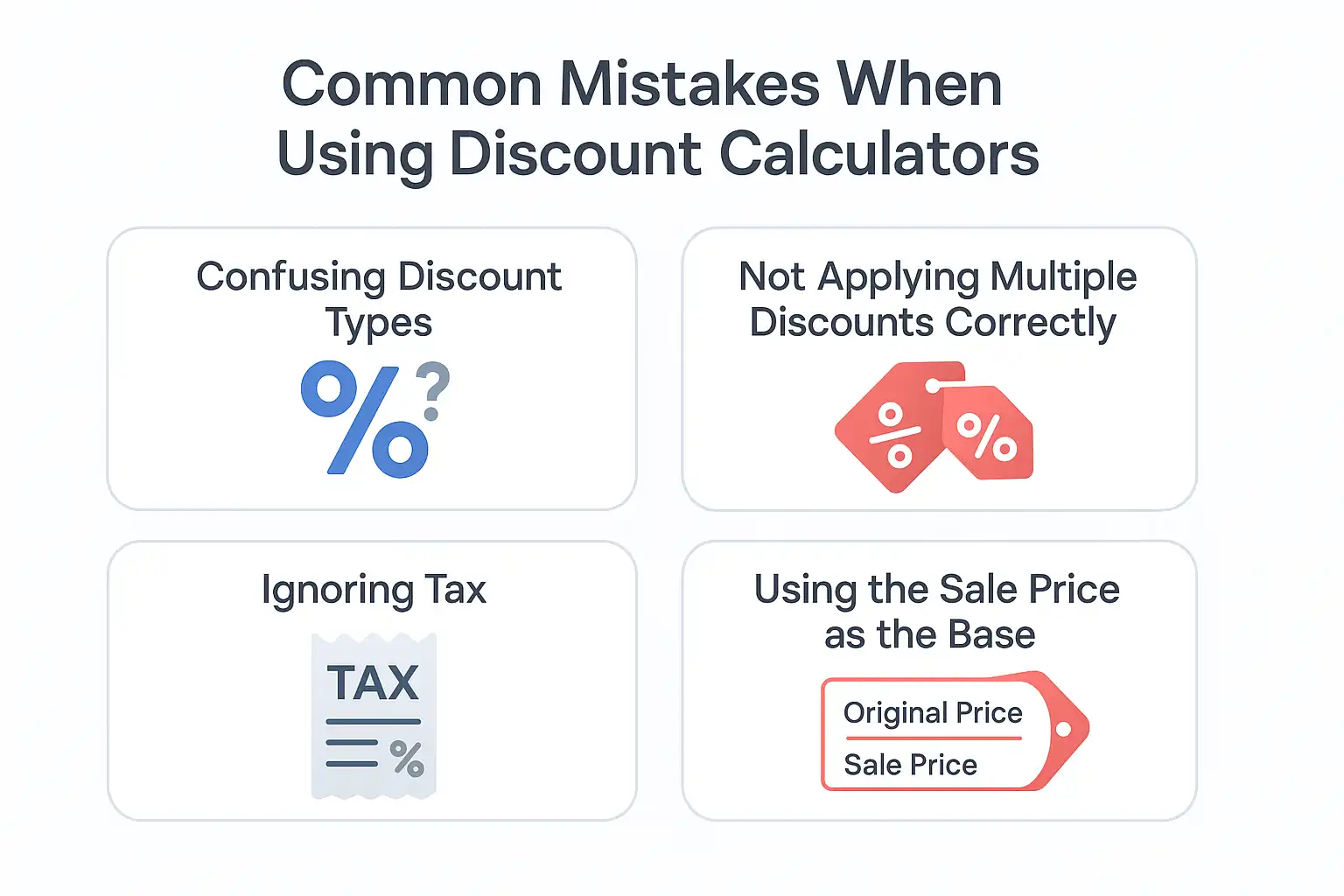
Common Mistakes When Using Discount Calculators

Using a discount calculator is easy, but accuracy depends on entering the right values. Here are the most common slip-ups to avoid.

Common Mistakes When Using Discount Calculators

Mistake 1: Confusing Discount Types

People often choose “percentage off” when it’s really a fixed dollar discount, or vice versa. This small misstep leads to totally different results.

Mistake 2: Not Applying Multiple Discounts Correctly

If you have a $20 coupon and then a 10% off promo, apply them sequentially, not together. The second discount should be on the already-reduced price.

Mistake 3: Ignoring Tax

Many forget to add sales tax after calculating the discount. This makes the total seem cheaper than what you’ll actually pay.

Mistake 4: Using the Sale Price as the Base

Entering the discounted price instead of the original price throws off your calculation, especially when trying to find the discount percentage.


Quick Reference Table: Mistakes & Fixes

Mistake What Happens Correct Way
Selecting wrong discount type Final price is way off Confirm if it’s percent or fixed
Stacking discounts incorrectly Inflated savings shown Apply one discount at a time
Not including tax Underestimates final total Add tax after discount
Using sale price as original price Overstates savings or % off Always input full original price

These little things make a big difference. I’ve made most of these errors myself—and learned that double-checking my inputs pays off just as much as the discounts do.

I remember when my dad tried to buy a new winter coat on sale. The tag said it was $150 with 30% off, but he somehow ended up paying over $120 at checkout. He swore the math didn’t add up. Turns out, he’d used a discount calculator but accidentally entered the sale price as the original price, making the savings look way bigger than they were.

On top of that, he forgot to factor in tax, which added another few dollars. He was frustrated, but we had a good laugh, and now he always double-checks with me before using any “deal” calculator.

Final Thoughts

For me, a discount calculator isn’t just a tool, it’s a way to make smarter choices when I shop. I use it to break down prices, avoid marketing tricks, and make sure I’m actually saving money. Once I started double-checking my numbers, I noticed how often the deals weren’t as good as they looked. Now, I never check out without it.

If you like understanding how your money grows or saves over time, try our Future Value Calculator it helps you see how your savings add up.

Frequently Asked Questions

Got questions? Our FAQs cover common topics about how our tools work, tips for accurate calculations, and guidance on using InterCalculator for everyday money decisions.

What is a Discount Calculator used for?

A Discount Calculator helps you quickly find the final price of an item after applying a discount. It’s useful for shopping, sales, or comparing deals without doing manual math.

Can I use the calculator for multiple discounts?

Yes, you can calculate multiple discounts by applying them one after another. For example, if a store gives 20% off and then an extra 10% off, you can enter them in sequence.

Why is the discount not the same as the amount saved?

A discount is expressed as a percentage, while the amount saved is the actual money reduced from the original price. The calculator shows both so you can clearly see the savings.

Does the calculator include taxes or shipping costs?

No, the calculator only applies the discount to the product’s listed price. Taxes, shipping, or extra fees should be added separately to find the true final cost.

Who can benefit from using a Discount Calculator?

Anyone who wants to quickly and accurately calculate discounts can benefit from a Discount Calculator. It is especially useful for shoppers comparing deals, students learning basic math, retailers setting sale prices, and businesses that need to apply discounts or promotions without errors.

Created by Editorial Team

This calculator was created by the InterCalculator Editorial Team, led by Haris Farooq (Formula & Development). Our team specializes in formula research, calculator logic, and technical development, ensuring each tool is accurate, fast, and easy to use.

View Editorial Team →
Accuracy Review Process:

Before publishing, every calculator goes through the InterCalculator Accuracy Review Process. For the Discount Calculator, we verify formulas against trusted retail pricing and percentage calculation standards. We test results across multiple shopping and sales scenarios to ensure the outputs are consistent with real-world pricing outcomes. All calculations are reviewed with an experienced pricing analyst to confirm accuracy, clarity, and reliability.

View Process →