
You just finished a practice test. Your hands are shaking. You’re thinking, “Did I do enough to get a 4 or 5?”
If you’ve felt this way, you’re not alone. Most students I’ve worked with wonder the same thing. That’s exactly why an AP Lang score calculator is so helpful. It takes away the guessing game.
This tool shows you how your multiple choice answers and essays add up to your final score. Whether you’re taking practice tests, checking your essay scores, or just want to know where you stand, we’ll walk through it all together.
By the end of this guide, you’ll know how to use the calculator, understand how your score is built, and see what your results mean for college. Let’s go.
How to Use the AP Lang Score Calculator
Using the calculator is simple. Here’s the step-by-step:
Step 1: Enter Your Multiple Choice Score
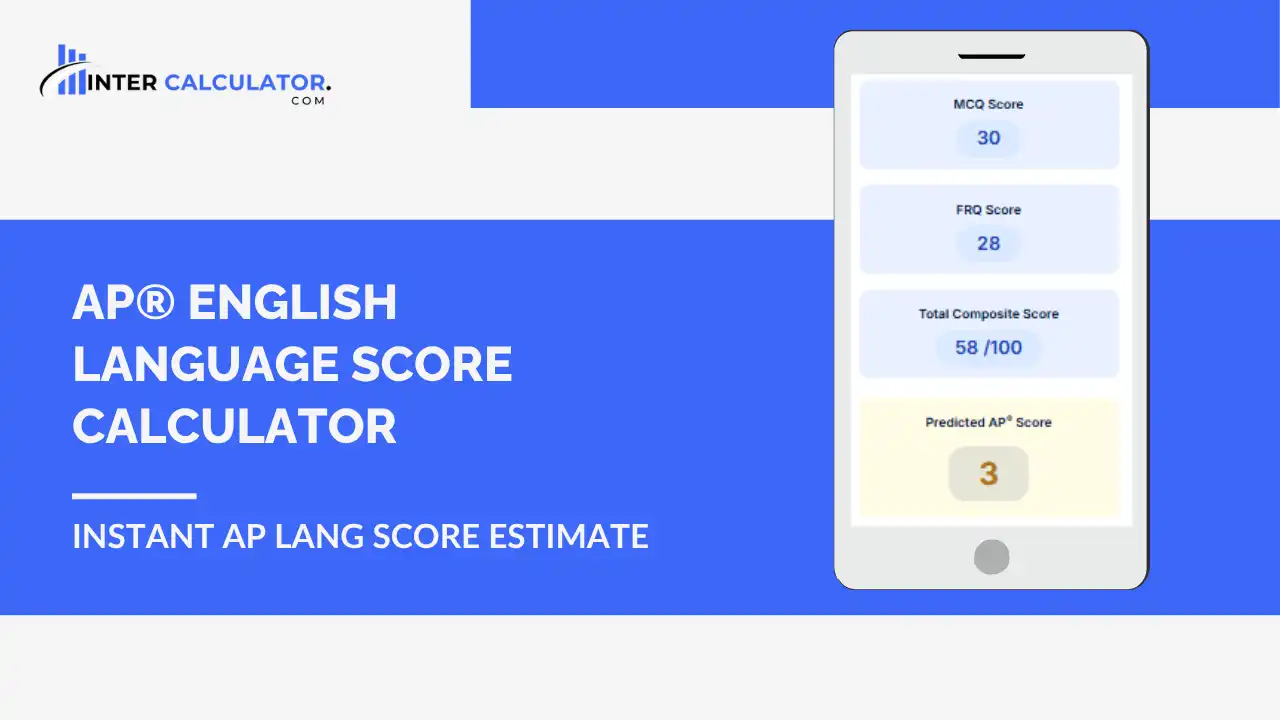
Go to the calculator and find Section I. Use the slider or type in how many multiple-choice questions you got right. If you got 30 out of 45 correct, just enter 30. The calculator shows your raw MCQ score right away.
Step 2: Add Your Essay Scores
Now scroll to Section II. You have three essays to score:
- Essay 1: Synthesis (how well you pulled from sources)
- Essay 2: Rhetorical Analysis (how well you explained the author’s choices)
- Essay 3: Argument (how strong was your own position)
Each essay gets a score from 1 to 6. If you think you got a 3 on synthesis, 4 on analysis, and 5 on argument, just type those in. The calculator adds them up.
Step 3: See Your Composite Score
Below your entries, you’ll see your total composite score. This combines your multiple choice and essay scores into one number, something like 58 out of 100 or 120 out of 150.
Step 4: Find Your Predicted AP Score
Right there on the screen, you’ll see your predicted score: 1, 2, 3, 4, or 5. This is what you’re likely to get on exam day.
Step 5: Pick Your Score Curve
Different years have different scoring curves. You can choose 2025, 2020, 2007, or older years. Each curve changes how your composite score translates to your final AP score. Try a couple to see how it works.
Step 6: Plan Your Next Moves
Change your scores up and down to see what happens. What if you got 2 more multiple choice right? What if your argument essay jumped to a 6? This helps you figure out what to focus on next.
Prepping for multiple AP exams? Once you’ve checked your Lang score, try our APUSH Score Calculator to see how your U.S. History prep stacks up, too. It works the same way: enter your scores, see your predicted 1–5, and plan your next moves with confidence.
I once worked with a student who realized she only needed 3 more correct answers on the MCQ section to jump from a predicted 3 to a 4. That one insight changed how she studied for the next month.
How the AP English Language Exam Actually Works
The AP Lang exam has two main parts. Each one tests different skills, and both matter a lot.
Section I: Multiple Choice (60 Minutes)
You get 45 questions based on real nonfiction passages. Some are older classics, some are new. You’ll read short excerpts and answer questions about what the author did. Did they use emotional language? Did they give strong evidence? Can you spot weak writing?
This section is 45% of your grade. That’s almost half. So yes, it matters.
You start here, and you have exactly one hour. Read the passages slowly. Don’t rush. Mark your answers carefully.
Section II: Free Response Essays (2 Hours 15 Minutes)
After a short break, you will write three essays. You get 15 minutes just to read the prompts and plan. Then you have 2 hours to actually write. Here’s what each essay asks:
- Essay 1 — Synthesis: Read several sources about a topic. Then write an essay using at least three of them to support your own idea.
- Essay 2 — Rhetorical Analysis: Read one passage. Explain how the author built their argument. What words did they choose? What examples did they use? Why?
- Essay 3 — Argument: Take a position on a general claim. Defend it with reasons, examples, and your own thinking.
These three essays make up 55% of your grade. That means your writing counts more than your multiple-choice score. If you’re strong at writing, you have a real advantage here.
I taught a group of juniors last year, and one of them said, “I didn’t know the essays were worth more than the MCQs.” Once she switched her study plan to focus more on essay practice, her score jumped. Knowing this early can change everything.
Quick View of the Exam
| Part | Time | Weight | What You Do |
|---|---|---|---|
| Multiple Choice | 60 min | 45% | Answer 45 questions about passages |
| Essays | 2 hr 15 min | 55% | Write 3 essays: synthesis, analysis, argument |
How Your AP Lang Score Gets Calculated
Your score isn’t random. It’s built from real numbers, and here’s exactly how it works.
Multiple Choice: The First Half of the Puzzle
You answer 45 questions. Every correct answer = 1 point. Wrong answer? Zero points. There’s no punishment for guessing, so always fill something in.
Add up all your correct answers. That’s your raw MCQ score. If you got 30 right, your raw score is 30.
That raw score gets scaled. It represents 45% of your final grade. So it matters, but the essays matter more.
Essays: The Bigger Piece
You write three essays. Each one is scored by a real person (or a group of people) using a rubric. The rubric looks at your ideas, your evidence, how clear you are, and how well you organized your thinking.
Each essay gets a score from 1 to 6. Add all three together. That’s your raw FRQ score. If you got 5 on synthesis, 4 on analysis, and 3 on argument, your total is 12 out of 18.
This 12 out of 18 gets scaled. It represents 55% of your final grade. So yes, if you’re better at writing than multiple choice, this is your strength.
Putting It Together: Your Composite Score
Both scores get weighted and combined. You end up with a composite score, usually out of 100 or 150 (depending on which calculator you use).
This composite score then maps to your AP score on a scale from 1 to 5. Here’s the typical range:
| Composite Score | AP Score |
|---|---|
| 108–150 | 5 |
| 92–107 | 4 |
| 76–91 | 3 |
| 50–75 | 2 |
| Below 50 | 1 |
These ranges shift a tiny bit each year. The College Board looks at how everyone scores nationally, then adjusts the cutoffs. That’s why using a calculator with the right year’s curve matters.
One of my students thought she couldn’t reach a 3. Then we looked at her numbers: she had 28 out of 45 on MCQ, and her essays were 4, 4, and 3. We realized that just two more correct multiple choice answers and a 1-point bump on her rhetorical analysis essay would push her composite past 75. She studied those two weak areas hard. Test day came. She got that 3. Her college accepted it for credit. Game changer.
What Score Do You Actually Need?
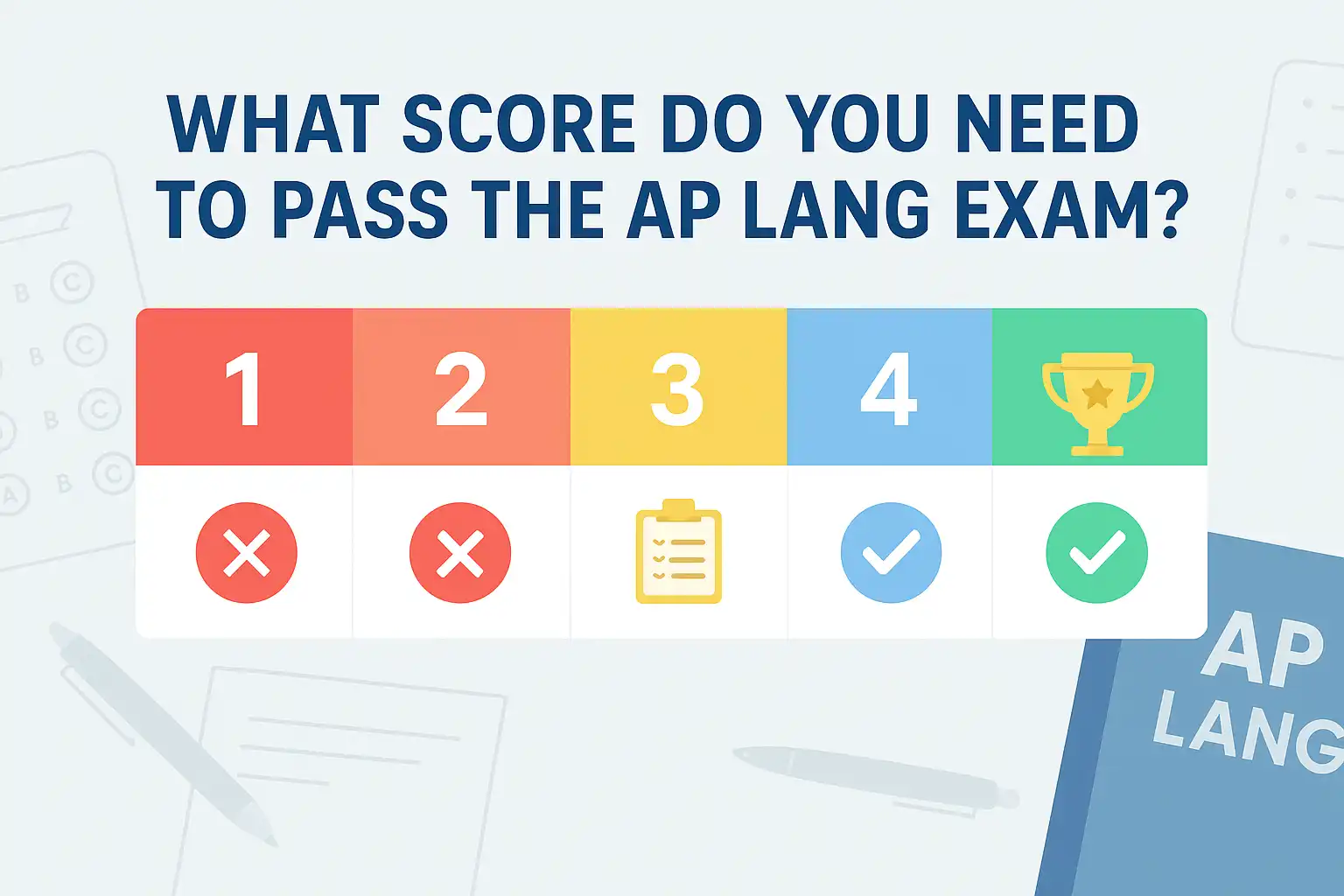
There’s no “pass” or “fail” on the AP Lang exam. But there are scores that colleges care about, and scores they don’t.
The Answer is: 3 Is the Sweet Spot
Most people say: if you get a 3 or higher, you did well. And honestly, that’s true for most situations.
But here’s the real breakdown:
- Score 5: You nailed it. Your essays were strong. Your multiple choice was nearly perfect. Colleges love this. You’re looking at full credit and placement out of freshman English.
- Score 4: Excellent work. You showed you can handle college-level writing. Most schools give you credit. Some let you skip the intro English.
- Score 3: You met the bar. You understand argument, synthesis, and rhetorical analysis. Many public universities accept this for credit. Private schools might want a 4, but this still counts.
- Score 2 or 1: Honestly, colleges don’t usually give credit for these. But they still see that you took a rigorous class and challenged yourself. That’s not nothing.
How Different Colleges Use Your Score
- Not every college treats AP scores the same way. Here’s what usually happens:
- Big public universities? A 3 often gets you college credit. You might skip a freshman writing class.
- Smaller private schools? They might want a 4 or 5. They’re more strict about it.
- Some schools don’t give credit at all. But they’ll place you in advanced courses so you don’t waste time on intro classes.
And here’s something many students don’t realize: even if you don’t get credit, that AP score tells colleges something. It says you can read complex writing. You can analyze arguments. You can write under pressure. These skills matter.
What You Might Get by Score
| AP Score | What It Unlocks |
|---|---|
| 5 | Full credit, skip freshman English |
| 4 | Credit or advanced placement at most schools |
| 3 | Credit at many public colleges |
| 2 or 1 | No credit, but still shows effort |
Before you decide what score you need, check your dream college’s AP Credit Policy using the official AP Credit Policy Search Tool. That’s where you see exactly what they do with AP Lang scores.
AP Lang Calculator vs. Doing the Math Yourself
Should you use a calculator tool, or just figure it out by hand? Let’s compare.
Why a Calculator Saves Time and Stress
A good calculator like the one at Intercalculator does three things right:
- It’s accurate. It follows the real AP rubrics and uses actual score curves from recent exams. No guessing about how the College Board scores you.
- It’s fast. You enter two numbers (MCQ and essays) and boom, you see your composite and predicted score instantly. No time wasted.
- It’s flexible. Try different curves from different years. Change one essay score and see how it affects your final number. This helps you figure out what to work on.
I’ve seen students get so much more confident just from seeing they’re only a few points away from their target score. That kind of insight only happens with a smart tool.
If you’re also preparing for the SAT, the same logic works there too. Our SAT score calculator gives you that same clarity, enter your section scores, see your predicted result, and know exactly what to work on next.
How to Do It Manually (If You Want To)
You can do this with paper and a calculator if you really want to.
- Count your correct multiple choice answers. If you got 32 out of 45 right, your raw MCQ is 32.
- Score your three essays. Use the rubric. Be honest. Add them up. Let’s say you got 4 + 5 + 3 = 12 out of 18.
- Scale both. Multiply your MCQ by about 2.5 (because it’s 45% of the grade). Multiply your FRQ by about 4.17 (because it’s 55% of the grade). Add them together. You get a rough composite.
- Compare that to the score chart. 115–150 is a 5. 95–114 is a 4. And so on.
Honestly? It’s doable. But you probably won’t know the exact scaling factors or the precise cutoffs for each year. You’ll get a ballpark answer, not a clear one.
When Manual Math Actually Helps
Manual estimation makes sense if:
- You’re offline and just want a rough idea of where you stand.
- You’re learning how the system works and want to understand the process.
- You’re teaching someone else and don’t have a screen nearby.
But if you’re prepping seriously for test day? Use the calculator. It’s clearer, faster, and way more reliable.
Some students I worked with used to estimate by hand every time. Then they tried Intercalculator. They said it was like going from guessing to actually knowing. Honestly, once you use a good tool, hand math feels slow.
Why We Built This Calculator
Here’s the truth: students kept asking us, “How do I know if I passed? What score do I need?” And we realized most score prediction tools out there were old, confusing, or didn’t match how the College Board actually scores anymore. We wanted to fix that. So we built the AP Lang calculator on Intercalculator.com with one goal: to make it simple, accurate, and actually helpful.
- Simple: You don’t need to be a math person. You enter two things (MCQ and essays), and you get your answer. That’s it.
- Accurate: We update it with real score curves from actual exam years. We use the real rubrics. We don’t guess.
- Helpful: We don’t just give you a number. We show you what that number means and how small changes in your scores affect your result.
We also saw how students who understood their score breakdown studied smarter. One student realized the free response section was worth more than she thought. She changed her study plan. She went from a predicted 2 to a 4. That’s the kind of shift we wanted to create.
So we didn’t build this to be just another calculator. We built it to feel like a teacher in your corner. Someone who shows you where you stand, and how to get where you want to go.
We keep it updated with new exam formats, new score curves, and easier-to-read visuals. Because every student, no matter where they are in their AP journey, should feel clear and in control.
Final Thoughts
You’ve now seen how the AP Lang exam works from start to finish. You know how your multiple-choice and essays turn into a composite score. You know what a 3, 4, or 5 actually means for your future.
Whether you use the calculator or work through it by hand, you’re not guessing anymore. You’re preparing with purpose. Next time you finish a practice test or walk out of that exam room wondering, “Did I do enough?” you’ll have the tools and knowledge to answer that with real clarity and confidence.
Frequently Asked Questions
What is an AP Lang Score Calculator?
An AP Lang Score Calculator estimates your potential AP English Language and Composition exam score. It uses your practice or real test section scores to predict the final 1–5 score scale.
How does the calculator predict my AP score?
The calculator applies the official AP exam weighting: multiple-choice questions typically count for 45% of the score, and free-response essays account for 55%. By entering your results, you get a projected AP score.
Can I use the calculator with practice test results?
Yes, many students use their practice exam or classroom test scores to see where they might stand. This helps identify strengths and areas that need improvement before the real exam.
Is the AP Lang Score Calculator 100% accurate?
No, the calculator gives a close estimate but not an exact guarantee. Final scores depend on official College Board scaling, which may vary slightly from year to year.
How can this calculator help me prepare for the exam?
This calculator was created by the InterCalculator Editorial Team, led by Haris Farooq (Formula & Development). Our team specializes in formula research, calculator logic, and technical development, ensuring each tool is accurate, fast, and easy to use.
View Team →Before publishing, every calculator goes through the InterCalculator Accuracy Review Process. For the AP Lang Calculator, we verify formulas against College Board scoring guidelines and AP exam standards. We test results across multiple exam score ranges and practice datasets to ensure reliable outcomes. All calculations are reviewed with an experienced education and testing expert to confirm accuracy, clarity, and reliability.
View Process →