
Want to know how fast your boat can really go? You’re not alone. Most boat owners wonder this before buying a new engine or planning a race. The boat speed calculator above gives you a quick answer based on horsepower and displacement.
This tool uses a proven formula that marine engineers and boat designers trust for preliminary design work. It’s the same method used by pros. Below, I’ll walk you through the formula behind it, what factors affect your boat’s speed, and how to get the most accurate results. Let’s get started.
How to Use the Boat Speed Calculator
Using this tool is super easy. Let me walk you through it step by step.
Step 1: Enter Your Shaft Horsepower
First, type in your engine’s horsepower. You can pick different units like watts, kilowatts, or mechanical HP. Most people use HP, so if you know your engine has 300 HP, just enter that.
Step 2: Add Your Boat’s Displacement
Next, enter your boat’s weight (also called displacement). You can use kilograms, pounds, metric tonnes, or other units. The tool changes everything behind the scenes, so pick what’s easy for you.
If you don’t know your exact weight, check your boat’s manual or the manufacturer’s website.
Step 3: Pick Your Boat Type
Now choose what kind of boat you have from the list. Are you using a cruiser? A racing boat? Maybe a hydroplane?
Each type gets a different Crouch constant number. Don’t worry about the math — the calculator does that for you.
Step 4: Click “Calculate Speed”
Hit that blue button and watch the magic happen. You’ll see your estimated top speed pop up right away.
The tool shows your speed in knots first, but you can change it to miles per hour (mph), kilometers per hour (km/h), or meters per second (m/s) using the dropdown.
Want to Know How Much HP You Need?
Here’s a cool trick. If you already know how fast you want to go, you can work backward.
Play with the horsepower numbers until you hit your target speed. This helps when you’re thinking about buying a bigger engine or making upgrades.
What is Boat Speed and How is it Calculated?
Boat speed is how fast your boat can move through water. Simple, right? But it’s not the same as a car or truck.
On land, you just look at engine power and weight. But boats are different because they push through water, not roll on a road.
The water pushes back. It creates drag and resistance. So even with a strong engine, a heavy boat moves slower than a light one with the same horsepower.
That’s where the power-to-weight ratio comes in. More power and less weight equals more speed. Makes sense.
Boat speed depends on two main things:
- Horsepower – How much power your engine makes
- Displacement – How much your boat weighs (or how much water it pushes away)
To calculate your top speed, we use something called Crouch’s formula. I’ll explain that in detail below, but here’s the short version: it’s a simple math equation that compares your power to your weight.
The heavier your boat, the more power you need to go fast. And the more HP you have, the faster you’ll go.
It’s all about balance.
Understanding Crouch’s Formula
Now let’s talk about the formula that makes this calculator work. It’s called Crouch’s formula, and it looks like this:
Don’t panic. It’s easier than it looks.
Here’s what each letter means:
- S = Speed (in knots or mph)
- P = Shaft horsepower (the power your engine makes)
- D = Displacement (your boat’s weight in pounds)
- C = Crouch constant (a number based on your boat type)
How Does It Work?
First, you divide your horsepower by your displacement. Then you find the square root of that number. Finally, you multiply by the Crouch constant.
The result? Your boat’s top speed.
Why Do Marine Designers Use This?
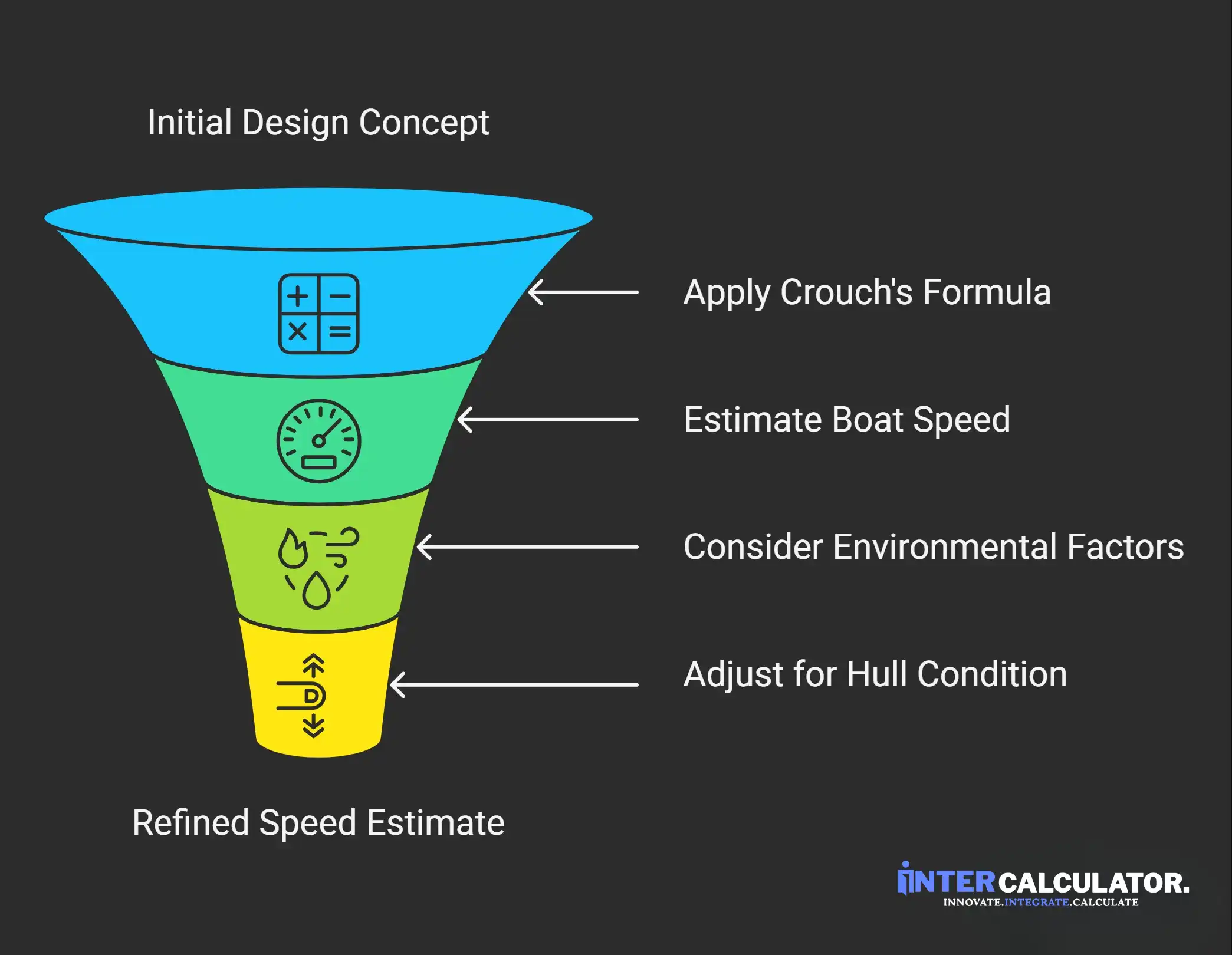
Crouch’s formula has been around for decades. Marine engineers and boat designers use it for preliminary design analysis. That means when they’re planning a new boat, they use this to guess how fast it will go before they even build it.
It’s fast, simple, and gets you close to the real answer.
But It Has Limits
This formula doesn’t care about hull length. It also ignores water conditions, wind, or how clean your hull is.
So the number you get is an estimate. Your real boat speed might be a little higher or lower depending on where and how you’re running. Still, it’s a great starting point.
What is the Crouch Constant?
The Crouch constant is just a number that changes based on what kind of boat you have. Different boats move through water differently, so they need different numbers.
Here’s the list:
- Cruisers and average runabouts: 150
- Passenger vessels: 190
- Light high-speed cruisers and high-speed runabouts: 190-220
- Racing boats: 240
- Hydroplanes: 250
- Racing catamarans and sea sleds: 260-270
According to a note from BoatDesign.net, “Crouch’s formula for planing speed … C = constant based on the type of vessel,” and the site lists similar constant ranges for common boat types.
Why the Difference?
It’s all about hull design. A heavy cruiser with a deep hull sits low in the water and moves more slowly. A racing boat or hydroplane has a flat, light hull that skims across the top.
The flatter and lighter your hull, the higher your constant, and the faster you go.
What It Doesn’t Include
One thing to know: the Crouch constant doesn’t care about hull length. A short boat and a long boat of the same type get the same number.
That’s not perfect, but it keeps the math simple. For most people, it works just fine.
Factors That Affect Boat Speed
The calculator gives you a number, but your real boat speed depends on a lot more than just horsepower and weight. Let me break down what really matters out on the water.
1. Horsepower & Engine Performance
This one’s obvious. More power means more speed. A 300 HP engine will push you faster than a 150 HP one on the same boat.
But here’s the thing: your engine also needs to be in good shape. Old spark plugs, dirty fuel, or a bad tune can cost you speed.
2. Boat Weight (Displacement)
Lighter boats win every time. If two boats have the same horsepower but one weighs 2,000 pounds and the other weighs 4,000, the lighter one will be way faster.
Think of it like this: would you rather carry a backpack or pull a wagon? Same idea.
3. Hull Design & Type
Your hull matters more than most people think. Planing hulls skim across the water at high speed. Displacement hulls push through it and move more slowly.
Racing hulls are flat and light. Cruising hulls are deeper and heavier. That’s why a racing boat with the same HP crushes a cruiser in speed.
4. Propeller Efficiency
Your propeller is where the rubber meets the road — or in this case, where the blade meets the water.
Propeller pitch (the angle of the blades) changes how much water you push with each spin. Too steep and your engine bogs down. Too flat and you lose speed.
There’s also something called prop slip. That’s when your prop spins but doesn’t push as much as it should. Most boats run 5-20% slip. The less slip, the faster you go.
5. Water Conditions
Calm water? You’ll hit your top speed easily. Choppy waves? You’re going to slow down.
Wind and current matter too. A strong headwind can knock 5-10 mph off your speed. Going with the current? You’ll fly.
6. Load & Weight Distribution
Every extra pound slows you down. A full fuel tank, heavy gear, and five passengers all add weight.
And it’s not just how much you carry — it’s where you put it. Too much weight in the back makes your nose lift and kills your speed; balance matters.
Quick Table:
| Factor | Impact on Speed |
|---|---|
| Horsepower | More HP = faster speed |
| Boat Weight | Lighter = faster |
| Hull Design | Racing/planing hulls are faster |
| Propeller Pitch | Right pitch = optimal speed |
| Prop Slip | Less slip (5-10%) = better performance |
| Water Conditions | Calm water = higher speed |
| Load Distribution | Balanced weight = better speed |
Boat Speed Calculator vs. Propeller Calculator
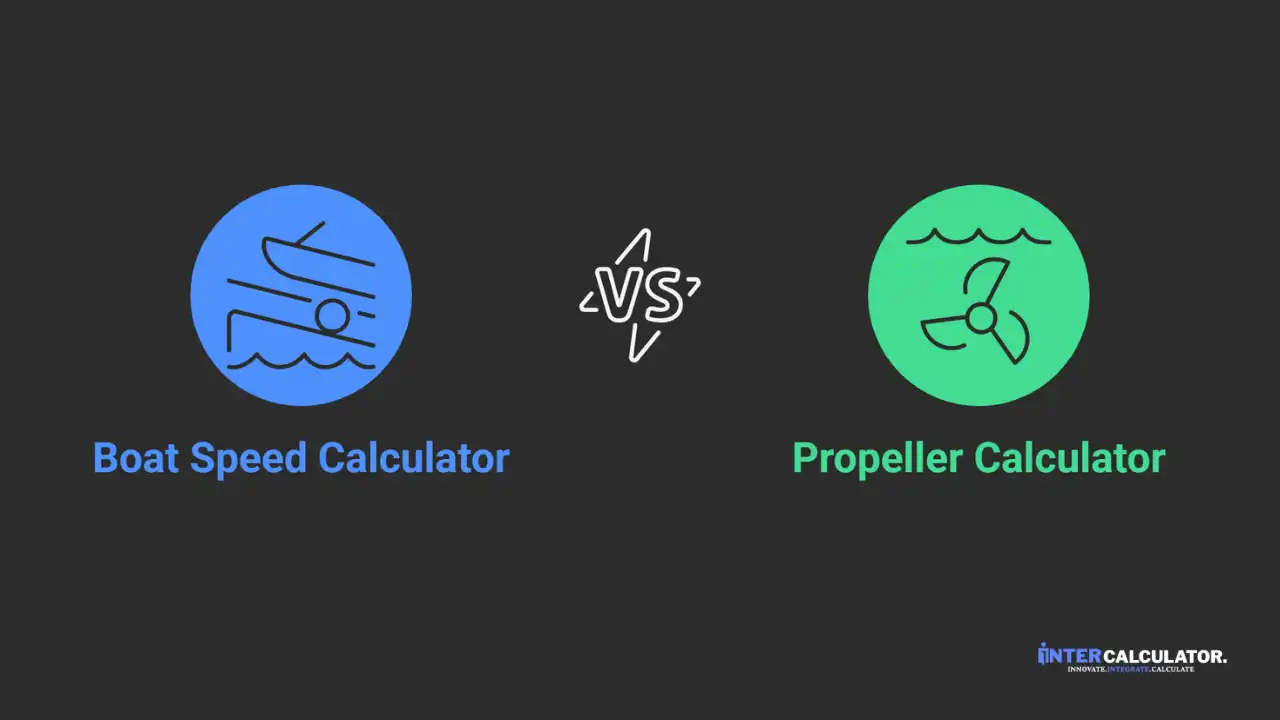
Boat Speed Calculator
A Boat Speed Calculator helps estimate how fast a boat can go based on engine power, weight, and hull type. It’s ideal for predicting performance, fuel efficiency, and planning safe travel speeds.
Propeller Calculator
A Propeller Calculator determines the best propeller size and pitch for optimal performance. It helps improve acceleration, top speed, and fuel economy by matching the right prop to your engine and boat setup.
Limitations and Accuracy of Boat Speed Calculators
Let’s be honest here. This calculator gives you an estimate, not an exact number.
It’s a tool for preliminary design and planning. Think of it like a GPS telling you how long a drive will take – close, but not perfect.
Real-World Factors That Change Your Speed
Your actual boat speed depends on a lot more than just math. Here’s what really matters when you hit the water:
- Hull condition makes a big difference. A clean hull moves faster than one covered in dirt and growth. Even a thin layer of slime can slow you down.
- Sea conditions change everything. Calm water? You’ll hit your estimated speed easy. Choppy waves and wind? You might lose 10-20% of your speed right there.
- Propeller efficiency matters too. An old, damaged, or wrong-sized prop won’t push you as fast as a new one that fits your boat perfectly.
- Engine tuning affects your real speed. A well-maintained engine with fresh spark plugs and clean fuel runs better than one that’s been ignored for years.
- Weight distribution can help or hurt. Too much weight in the back lifts your nose and kills speed. Balance your load right and you’ll go faster.
How Accurate Is This Calculator?
The number you get is usually within ±5-15% of the actual speed. That’s pretty good for planning, but don’t bet your life on it.
Some boats run faster than predicted. Others run slower. It depends on all those factors I just mentioned.
What This Tool Is Good For
Use this calculator to compare different setups. Want to know if a 250 HP engine is worth the upgrade over a 200 HP engine? This tool shows you the difference.
Planning upgrades? This helps you decide if a new engine or losing weight makes more sense.
But here’s the bottom line: always test on water for real performance. No calculator beats actual experience. Take your boat out, run it at full speed, and measure with GPS. That’s your real number.
Why We Built This Boat Speed Calculator
We built this tool because we kept seeing boat owners make expensive mistakes. A friend once spent $15,000 on a bigger engine, thinking it would push his cruiser to 50 mph. He only hit 38. Why? His boat’s weight was too heavy for that horsepower. The power-to-weight ratio wasn’t right. We heard similar stories from dozens of people who wasted money because they couldn’t estimate their boat speed before upgrading.
That’s why we created this calculator, something fast, simple, and accurate enough to help you make smarter choices. Enter your HP and displacement, get your answer in seconds, and avoid costly mistakes. We’re boat people too, and we hope this tool saves you time and money on the water.
Final Thoughts
There you have it, everything you need to know about using a boat speed calculator. Whether you’re planning to buy a new engine, comparing different boats, or just curious about your top speed, this tool gives you a quick and reliable answer. Remember, the number you get is an estimate based on Crouch’s formula, so your real-world speed might vary a bit depending on water conditions, hull cleanliness, and how well your propeller is matched to your setup.
But for planning and comparing options, this calculator does the job. Give it a try, play with different numbers, and see how changes in horsepower or boat weight affect your speed. And when you’re ready, take your boat out and test it for real; that’s where the fun really begins. Safe travels on the water.
If you liked this, explore more tools like our Audiobook Speed Calculator for reading pace, or the Asphalt Calculator for construction planning
Frequently Asked Questions
What is a good horsepower-to-weight ratio for a boat?
It depends on your boat type. Cruisers typically need about 10-15 HP per 1,000 pounds. High-speed runabouts work best with 20-30 HP per 1,000 pounds. Racing boats can go even higher – 40+ HP per 1,000 pounds. Heavier boats need more power to reach good speeds.
Does hull length affect boat speed?
Yes, absolutely. Longer hulls can go faster than shorter ones. There’s something called hull speed – a limit based on length. But Crouch’s formula doesn’t include hull length in the math. It focuses only on power and weight. So this calculator gives you a general estimate, not a perfect number.
Why is my boat slower than the calculator predicts?
Several reasons. Prop slip might be higher than normal (over 20%). A dirty hull with growth and slime slows you down. Rough water conditions add drag. Your propeller pitch might not match your setup. Or your engine needs tuning. Check these things first.
Can I use this for sailboats?
No, don’t use this calculator for sailboats. Sailboats work on totally different physics. They use displacement hulls that push through water, not planing hulls that skim on top. Sail power is nothing like engine horsepower. You need a different tool for that.
What's the difference between shaft HP and rated HP?
This calculator was created by the InterCalculator Editorial Team, led by Haris Farooq (Formula & Development). Our team specializes in formula research, calculator logic, and technical development, ensuring each tool is accurate, fast, and easy to use.
View Team →Before publishing, every calculator goes through the InterCalculator Accuracy Review Process. For the Boat Speed Calculator, we verify formulas like Crouch’s equation against trusted marine engineering sources and test results across multiple boat types and power-to-weight scenarios. All calculations are reviewed with experienced naval engineers and boating experts to confirm accuracy, clarity, and reliability.
View Process →