
You make your monthly payment on time, check your loan statement, and somehow your total balance is higher than last month. If this sounds familiar, you’re not alone – millions of borrowers watch their debt grow even when they’re paying religiously, and it’s not because of some banking conspiracy or hidden fees designed to trick you.
The truth is, loan balances can increase for several legitimate reasons that most people never learn about when they first borrow money. Whether it’s your student loan, credit card, mortgage, or personal loan, understanding these balance-boosting factors can save you thousands of dollars and years of frustration.
I’ve helped hundreds of people figure out why their principal balance keeps climbing, and once you know what’s happening behind the scenes, you can take control and stop the cycle. Let me walk you through exactly what causes loan balances to grow and, more importantly, how you can prevent it from happening to your hard-earned money.
What Increases Total Loan Balance
Your total loan balance grows when interest, fees, or missed payments get added on top of what you already owe. Even if you’re making payments, certain factors can still cause your balance to rise instead of fall.
Common reasons loan balances increase:
- Unpaid interest added to your principal (interest capitalization)
- Variable interest rates going up over time
- Minimum payments that don’t cover monthly interest
- Missed or late payments that trigger fees and penalties
- Deferred payments or forbearance where interest keeps building
- Escrow shortages on mortgages or added charges to auto/student loans
The key is awareness, once you know how balances grow, you can take steps to avoid surprises and keep your debt shrinking.
Core Factors That Increase Your Total Loan Balance
Interest is the sneaky culprit behind most growing loan balances, and it works in ways that can catch even smart borrowers off guard. When your interest rate changes or when unpaid interest gets rolled into your principal, your debt can snowball faster than you ever imagined.
Variable Interest Rates
Variable interest rates are like weather – they change without asking your permission first. Your credit card, student loan, or adjustable-rate mortgage might start with a sweet 4% APR, but when market conditions shift, that rate can jump to 8%, 12%, or even higher.
I remember when my friend Sarah got hit with this exact scenario. Her credit card rate climbed from 16% to 24% in just six months during 2022’s rate hikes. Even though she kept making the same monthly payment, her balance actually grew because the interest charges outpaced what she was paying.
Federal Reserve decisions, prime rate changes, and economic conditions all affect variable rates. If you’re carrying a balance when rates rise, you’ll pay more interest each month – sometimes hundreds more – without borrowing a single extra dollar.
Interest Capitalization and Accrual Scenarios
Interest capitalization sounds fancy, but it’s really just your lender saying “we’re adding your unpaid interest to your principal balance.” This happens most often with student loans during grace periods, forbearance, or deferment.
Here’s how it works: Let’s say you have a $30,000 student loan at 6% interest. During your six-month grace period after graduation, interest keeps building – about $150 per month. If you don’t pay that interest, your lender adds the full $900 to your loan balance, making it $30,900 before you even start repayment.
Subsidized federal student loans protect you from this during school, but unsubsidized loans and private student loans let interest grow from day one. The capitalized interest then earns its own interest – it’s compound growth working against you instead of for you.
Payment-Related Issues
Your payment habits have more power over your loan balance than almost anything else. Missing payments, paying late, or paying less than the minimum can all trigger balance increases through fees, penalty rates, and compounding interest.
Missing or Late Payments
Missing payments is like stepping on a financial landmine – the damage spreads far beyond just that one skipped payment. Let’s say you have a $5,000 credit card balance at 22% APR. If you miss your April payment, you’ll get hit with a $30 late fee plus another $90 in interest charges that month. Your balance jumps to $5,120 before you’ve charged a single thing.
Many lenders will bump you up to a penalty APR – sometimes as high as 29.99% – after just one missed payment. That higher interest rate applies to your entire balance going forward. Even late payments can trigger these penalties, and most lenders have specific cut-off times, not just dates. Submit your payment at 9:01 PM when they stop processing at 9:00 PM, and you’re officially late.
Paying Less Than the Minimum
Paying less than the minimum is like trying to fill a bucket with a hole in the bottom – you’re working hard, but you’re not making progress. Lenders calculate minimum payments to cover at least the interest charges plus a tiny bit of principal. Pay less, and your balance starts growing instead of shrinking.
If your minimum payment is $150 and you pay $100, that missing $50 doesn’t just disappear. Your lender treats this as a partial payment, which often means late fees get triggered. The unpaid interest gets added to your principal balance, and you’re charged interest on that interest going forward.
Credit card companies are especially strict here – many consider any payment under the minimum as late, even if you paid something. Student loans handle this differently depending on the type, but the math is unforgiving: Interest compounds daily on most loans, so every dollar you don’t pay today costs you more tomorrow.
Authorized Payment Modifications
Sometimes life hits hard, and lenders offer ways to temporarily reduce or pause your payments without destroying your credit. These authorized payment modifications can be lifesavers during tough times, but they often come with a hidden cost – your loan balance can grow significantly while you’re getting relief.
Deferred Payment Plans
Deferred payment plans let you push payments to later without the penalties of simply missing payments. Your lender agrees to the arrangement, so you won’t get late fees or credit score damage. But here’s the catch – interest usually keeps building the entire time.
Private student loans are the perfect example of how deferred payments can backfire. While you’re in school, your lender lets you skip payments completely. Sounds great, right? But that interest is compounding every single day.
Let’s say you borrow $40,000 for college at 7% interest. Over four years of deferment, you’ll rack up about $12,000 in unpaid interest. When you graduate, your loan balance has grown to $52,000 – and now you’re paying interest on that larger amount for the next 10-20 years.
Mortgage deferred payment plans work differently. If you’re struggling, your lender might let you reduce payments temporarily, but the missing amounts get added to the end of your loan. Your principal balance stays the same, but your loan term extends, meaning you’ll pay more interest over time.
Forbearance or Deferment
Forbearance and deferment sound similar, but they work differently depending on your loan type. Both let you pause or reduce payments, but the interest rules can vary dramatically.
Federal student loan deferment sometimes stops interest from growing – but only on subsidized loans. The government pays your interest while you’re unemployed, in school, or facing other qualifying hardships. Unsubsidized loans keep building interest that gets capitalized when deferment ends.
I had a client who used forbearance on her student loans during a job loss. She thought she was being smart by avoiding default, but after 12 months, her $30,000 balance had grown to $32,400. That extra $2,400 in capitalized interest increased her monthly payments by about $25 for the life of the loan.
Credit card forbearance – often called a hardship program – might lower your minimum payment or freeze interest temporarily. But many programs still let some interest accrue, and promotional rates usually end after 6-12 months.
Auto loan forbearance typically just moves payments to the end of your loan term. Your balance doesn’t grow, but you’ll be making payments longer than originally planned.
Want to see how delaying or extending payments could affect your car loan? Use our Payoff Car Loan Calculator to check how long it will really take to become debt-free.”
Student Loan Forbearance vs Mortgage Forbearance Differences
Student loan forbearance and mortgage forbearance might sound like the same thing, but they work completely differently – and understanding these differences can save you thousands.
Student loan forbearance
Student loan forbearance almost always lets interest keep building. Whether it’s federal or private, that interest typically gets capitalized when forbearance ends, permanently increasing your principal balance. You might pause payments for a year, but your balance could grow by 5-7% during that time.
Mortgage forbearance
Mortgage forbearance usually works differently. During the COVID-19 pandemic, most mortgage forbearance programs didn’t let interest compound or get added to your principal. Instead, the missed payments were either added to the end of your loan or had to be repaid through a separate payment plan.
The big difference? Student loan forbearance often makes your total debt permanently higher. Mortgage forbearance usually just extends your payment timeline without increasing the principal balance.
Federal student loans have better protections than private loans. You can often get forbearance more easily, and some newer programs limit how much interest can capitalize. Private student loans have fewer protections, and lenders can be pickier about approving forbearance.
Mortgage lenders, especially after 2008, are usually required to work with struggling borrowers. Forbearance options are more standardized, and there are often government programs that provide additional protections.
The key takeaway? Student loan forbearance can significantly increase your total debt, while mortgage forbearance usually just changes your payment schedule without permanently growing your balance.
If you’re trying to see how forbearance or changes in your payment schedule could affect your monthly costs, try our Mobile Home Loan Calculator to run the numbers in real time.
Fees and Additional Costs
Fees are the sneaky budget killers that can turn a manageable loan into a growing financial nightmare. Most borrowers focus on interest rates and monthly payments, but it’s often the fees and additional costs that push loan balances higher than anyone expected.
Complete Breakdown of Loan-Related Fees
Loan fees come in more flavors than ice cream, and each one can potentially increase your total balance. Understanding exactly what you might face helps you avoid surprises and plan better payment strategies.
Origination fees
Origination fees are the most common upfront costs. Your lender charges a percentage – usually 0.5% to 6% – to process your loan application, run underwriting, and set up your account. Here’s the kicker: most lenders let you roll this fee into your loan balance instead of paying it separately.
Let’s say you borrow $20,000 for a personal loan with a 3% origination fee. That’s $600 added to your principal before you even get the money. You’ll receive $19,400 but owe $20,600 from day one. Over a five-year loan term, you’ll pay interest on that extra $600 the entire time.
Late payment fees
Late payment fees are where lenders really make money from mistakes. Credit card late fees can hit $40 for your first offense and go up from there. According to the Federal Reserve’s G.19 Consumer Credit Report, the average APR for credit cards accruing interest rose to 22.25% in Q2 2025, up from 21.91% in Q1 2025. This means that even if you avoid late fees, the underlying interest rate on credit card debt continues to climb. Mortgage late fees are often 4-5% of your monthly payment. On a $2,000 mortgage payment, that’s $80-$100 just for being a few days late.
The real pain comes when late fees get added to your principal balance. That $40 credit card late fee doesn’t just disappear after you pay it – it becomes part of your balance that earns interest at your card’s APR. At 24% interest, that fee costs you an extra $10 per year until you pay down that portion of your balance.
Returned payment fees
Returned payment fees kick in when your payment bounces due to insufficient funds. Banks typically charge $25-$35 for NSF fees, and your lender adds their own returned payment fee on top. You’re looking at $50-$70 in total fees for one bounced payment – and most of that gets added to your loan balance.
When Closing Costs Get Added to Your Loan Balance
Closing costs on mortgages and home equity loans can easily hit $5,000-$15,000, and many lenders offer to roll these into your loan to keep your out-of-pocket costs low. It sounds convenient, but it means you’re paying interest on those fees for 15-30 years.
I recently helped a family refinance their home, and they were shocked to learn their closing costs would add $180 to their monthly payment over the loan’s life. Appraisal fees, title searches, attorney fees, recording costs – every single expense they rolled into the loan became a permanent part of their mortgage balance.
Points are another closing cost that increases your balance. Each point costs 1% of your loan amount but reduces your interest rate. Some borrowers finance the points instead of paying them upfront, which means they’re borrowing money to buy a lower interest rate. The math only works if you keep the loan long enough for the rate savings to offset the financed points.
Home equity lines of credit often have lower closing costs, but lenders might charge annual fees, inactivity fees, or early closure fees that can get added to your balance if you don’t pay them separately. A $50 annual fee might not sound like much, but over a 10-year draw period, that’s $500 in fees earning interest at your line of credit’s rate.
The key is asking your lender upfront: “What fees can be financed, and what’s the total cost if I roll them into my loan?” Sometimes paying fees out-of-pocket saves you hundreds or thousands over the loan’s life, even if it hurts your cash flow initially.
Taking Out Another Loan
Additional borrowing is one of the most obvious ways your total loan balance increases, but it’s not always as straightforward as it seems. Sometimes you’re deliberately borrowing more money, and other times lenders make it so easy to access extra funds that your balance grows almost without you noticing.
Cash-Out Refinancing and Balance Increases
Cash-out refinancing lets you replace your current mortgage with a bigger one and pocket the difference in cash. It sounds like free money, but you’re actually increasing your total debt and monthly payments significantly.
Here’s how it works: Let’s say you owe $150,000 on your mortgage, but your home is worth $300,000. You refinance for $200,000, pay off the original $150,000 loan, and get $50,000 cash. Your mortgage balance just jumped by $50,000, and you’ll be paying interest on that extra amount for the next 15-30 years.
Cash-out refinancing turns unsecured debt into secured debt backed by your home. The interest rate is usually higher than regular refinance rates, and you’ll pay closing costs on the entire new loan amount.
Credit Line Advances and HELOC Draw Periods
Home equity lines of credit work like giant credit cards secured by your home. During the draw period (usually 10 years), you can borrow money, pay it back, and borrow again. Your balance goes up every time you take an advance.
HELOC interest rates are usually variable, tied to the prime rate. When rates rise, your monthly payment can double or triple, especially if you’ve been making interest-only payments.
The real shock comes when the draw period ends. A $50,000 HELOC balance that was costing $200 per month in interest-only payments might jump to $500+ per month when principal payments kick in.
The key with any credit line is treating each advance like a separate loan with its own repayment timeline.
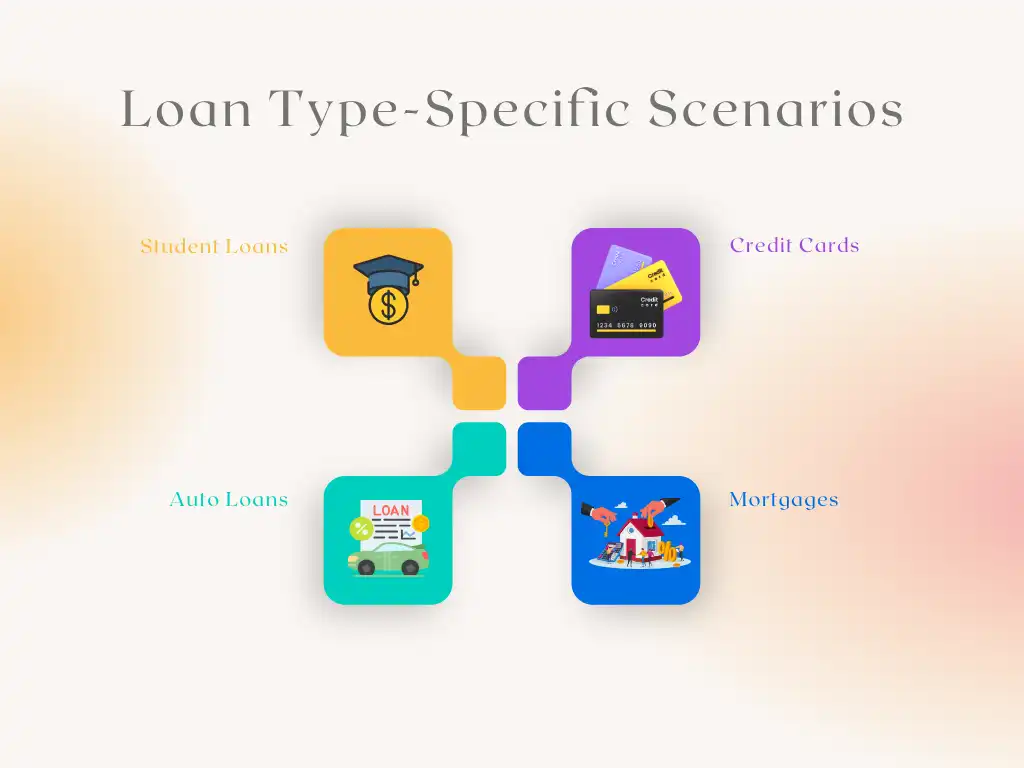
Loan Type-Specific Scenarios
Different loan types have unique ways of making your balance grow, and what works for one type of debt can backfire spectacularly on another. Understanding these differences helps you avoid the specific traps that each loan category sets for unwary borrowers.
Student Loans
Student loans can look simple at first, but they grow in tricky ways that catch many borrowers off guard. Most balance increases come from interest capitalization, which adds unpaid interest to your principal after grace periods or forbearance. Subsidized loans pause interest while you’re in school, but unsubsidized and PLUS loans start right away, and income-driven plans may still grow your balance unless you’re on the new SAVE plan.
Credit Cards
Credit cards often grow because of how minimum payments are designed to keep you in debt for longer. One late payment can trigger a penalty APR, jumping your rate from 18% to nearly 30% across the whole balance. Rates also rise with the prime rate, and even balance transfers add 3–5% in fees to your total instantly.
Mortgages
Mortgage balances usually shrink, but they can rise when escrow shortages add tax or insurance jumps to your loan. Adjustable-rate mortgages can raise costs when interest rates climb, while modifications roll missed payments and fees into your balance. Cash-out refinancing always grows your loan since you replace it with a bigger one, and not removing PMI on time means extra costs.
Auto Loans
Auto loan balances often increase because cars lose value faster than the loan gets paid off, creating negative equity. Financing add-ons like warranties or service contracts boosts your balance right away and adds long-term interest. Refinancing an underwater loan rolls your debt into a new one, while gap insurance may still leave leftover debt after an accident or theft.
Tips to Keep Your Loan Balance From Increasing
Preventing your loan balance from growing takes smart planning and consistent action, but the strategies are simpler than most people think. Here are the most effective ways to keep your debt moving in the right direction – downward.
- Set Up Automatic Payments for Rate Discounts – Many lenders offer 0.25% to 0.50% interest rate reductions for autopay enrollment. Schedule payments a few days after payday to avoid insufficient funds.
- Make Bi-Weekly Payments Instead of Monthly – Making 26 bi-weekly payments equals 13 monthly payments per year. That extra payment goes directly to principal, cutting years off your loan term.
- Pay More Than the Minimum Every Month – Even an extra $25-50 monthly goes straight to principal reduction. Adding $50 to a $20,000 student loan payment saves about $3,000 in interest and cuts two years off repayment.
- Avoid Variable Rate Products When Rates Are Rising – Choose fixed-rate loans for major borrowing. For existing variable debt like credit cards or HELOCs, prioritize paying these down first.
- Monitor and Pay Accrued Interest During Deferment – Pay at least the monthly interest during forbearance or deferment to prevent capitalization. Even small interest-only payments can save hundreds in capitalized interest later.
Final Thoughts
Your loan balance doesn’t have to be a mystery that grows bigger each month despite your best efforts to pay it down. Now that you understand how variable interest rates, missed payments, interest capitalization, and fees can work against you, you have the power to stop the cycle and take control of your debt.
Start by setting up automatic payments to avoid late fees and earn rate discounts, pay more than the minimum whenever possible, and keep a close eye on variable rate products that can spike your costs overnight. Remember, every extra dollar you put toward principal today saves you multiple dollars in interest tomorrow – and that’s the real secret to making your loan balances shrink instead of grow.
Frequently Asked Questions
Why is my payoff amount higher than my balance?
Your payoff amount includes accrued interest that’s built up since your last statement, plus any unpaid fees. Interest accumulates daily, so even a few days can add $10-50 to your payoff amount depending on your balance and rate.
Can loan companies legally increase my balance?
Yes, lenders can legally increase your balance through late fees, returned payment charges, and interest capitalization as outlined in your loan agreement. However, lenders cannot randomly add fees without following your contract terms and applicable laws.
How long does interest capitalization take to occur?
Student loan interest typically capitalizes at the end of grace periods, when forbearance ends, or when leaving certain repayment plans. Credit card interest compounds monthly and gets added to your balance immediately.
What’s the difference between forbearance and deferment?
Deferment is for specific situations like unemployment and may stop interest on subsidized federal loans. Forbearance is more flexible but interest almost always keeps accruing and gets capitalized when it ends.
Can I prevent my student loan balance from growing?
Yes, you can prevent growth by making interest-only payments during grace periods, forbearance, or deferment. Even paying just the accrued interest each month stops capitalization from increasing your principal balance.