
Asphalt projects can get confusing fast. You measure the area, stare at the numbers, and then wonder. how many tons of asphalt do I actually need? I’ve been there. It feels like guesswork, and honestly, ordering too much or too little both cost you money.
That’s exactly why an asphalt calculator exists. Whether you’re planning a residential driveway, a commercial parking lot, or a road construction job, this tool gives you instant estimates for tonnage, cost, and coverage area, all in one place.
Just enter your length, width, and thickness, and you get your answer in seconds. No math headaches. No wasted trips to the supplier. Just clear numbers you can actually use.
Our calculator works for every project size, from a small driveway patch to a full commercial paving job. It uses industry-standard density values so your estimate is always reliable and close to what a professional paving contractor would calculate.
Asphalt projects can get confusing fast. You measure the area, stare at the numbers, and then wonder. how many tons of asphalt do I actually need? I’ve been there. It feels like guesswork, and honestly, ordering too much or too little both cost you money.
That’s exactly why an asphalt calculator exists. Whether you’re planning a residential driveway, a commercial parking lot, or a road construction job, this tool gives you instant estimates for tonnage, cost, and coverage area, all in one place.
Just enter your length, width, and thickness, and you get your answer in seconds. No math headaches. No wasted trips to the supplier. Just clear numbers you can actually use.
Our calculator works for every project size, from a small driveway patch to a full commercial paving job. It uses industry-standard density values so your estimate is always reliable and close to what a professional paving contractor would calculate.
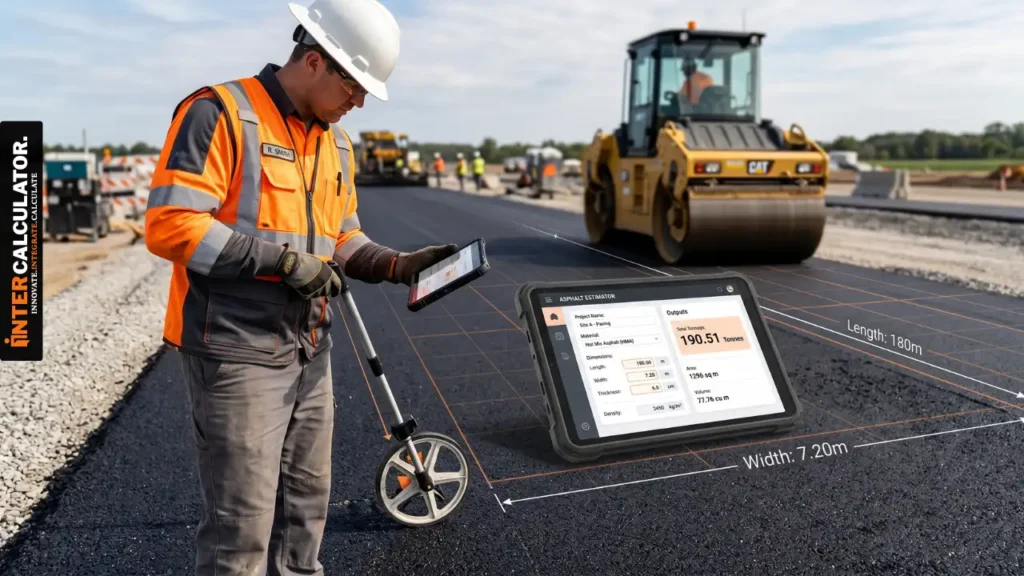
Using this calculator is really simple. Even if you have never done a paving project before, you can get your tonnage estimate in less than a minute. Here is how to do it, step by step.
| 1 | Pick Your Unit SystemFirst, choose whether you want to work in imperial (feet and inches) or metric (meters and centimeters). If you are in the US, you will most likely use imperial. Just click the option that works for you before entering anything else. |
| 2 | Enter Your Length and WidthNow measure the area you want to pave. Enter the length and width of your project. If your space is not a perfect rectangle, that is okay. Just break it into smaller rectangles, calculate each one, and add the results together. I do this all the time for L-shaped driveways, it works perfectly. |
| 3 | Set Your Asphalt ThicknessThis is the part most people get wrong the first time. Enter your planned compacted thickness in inches or centimeters. A quick tip, if you want to enter 1/4 inch, type 0.25, not 1/4. The calculator only reads decimal values, not fractions. |
| 4 | Add a Price Per Ton (Optional)If you already know the price per ton from your local asphalt supplier, enter it here. The calculator will then show you an estimated total project cost on top of the tonnage number. If you don’t know the price yet, skip this field, you can still get your weight and volume results. |
| 5 | Hit Calculate and Read Your ResultsClick the calculate button. You will instantly see your total volume in cubic feet, your total tons of asphalt needed, and your estimated cost if you entered a price. Always add 5 to 10% extra on top of your result to cover waste and compaction loss. That small buffer has saved me from running short on more than one job. |
Asphalt is one of those things we drive on every single day but rarely think about. So let’s break it down in the simplest way possible.
Asphalt concrete is made of two main things, aggregates and bitumen. Aggregates are small stones, gravel, and sand. Bitumen is a thick, black, sticky liquid made from petroleum. It acts like glue, it coats all those stones and holds them together.
When the mix has more stones and less bitumen, we call it blacktop. You see blacktop on most home driveways and residential roads. It is not as strong as regular asphalt concrete, but it is good enough for everyday cars and light traffic.
One thing I really like about asphalt is that it stays a little flexible after it cures. That means it can handle small ground movements without cracking as easily. Cement concrete, on the other hand, is hard and rigid, one shift in the ground and you get a crack straight through it.
If you are still weighing your options for a driveway or patio, run your measurements through our Concrete Calculator to compare material needs, or check the Concrete Cost Calculator to see which option fits your budget better
Hot mix asphalt, or HMA, is the most common type used today. It is made at high heat, which makes it easy to spread and compact. You will find it on driveways, parking lots, and most roads.
Then there are specialty types, like polymer-modified asphalt and rubber hotmix. These are used in places that need extra strength or flexibility, like highways with very heavy traffic or areas with extreme weather.
Honestly, for most home or small commercial jobs, standard hot mix asphalt does the job well. But because density and durability change slightly depending on the mix design, it is always smart to ask your local asphalt supplier which mix fits your project best before you order.
Getting the thickness wrong is one of the most expensive mistakes in any paving project. I have seen homeowners pour a thin 1.5-inch layer to save money, and then spend double fixing cracks two years later. The right asphalt depth from day one saves you money in the long run. Every time.
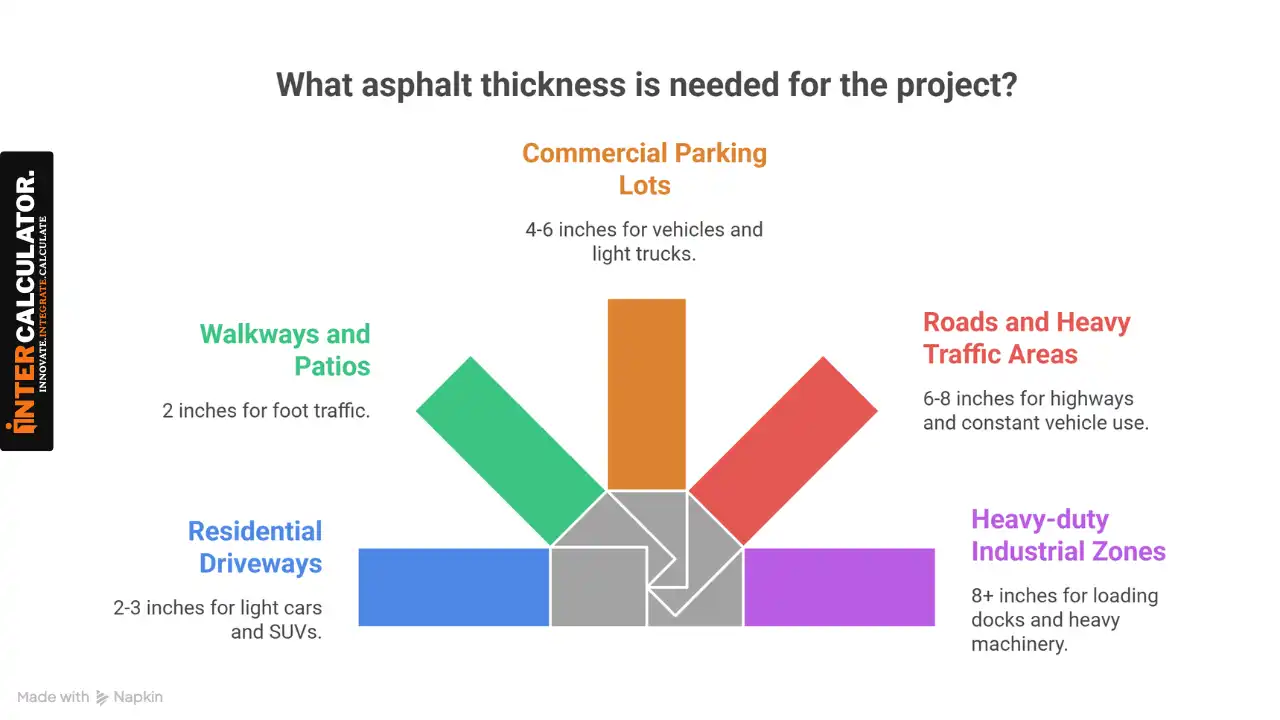
Here is the honest truth, there is no one-size-fits-all number. The right compacted thickness depends on what the surface will be used for.
The standard is 2 to 3 inches of hot mix asphalt. Two inches works for light cars and normal use. If you have an SUV or expect the occasional delivery truck pulling in, go to 3 inches. It is worth the small extra cost.
These are lighter-use surfaces, so 2 inches is usually enough. These spots carry foot traffic, not cars, so you do not need the same depth.
These surfaces handle dozens of vehicles every day, including vans and light trucks. The recommended asphalt thickness here is 4 to 6 inches. For areas like drive lanes and loading zones inside the same lot, lean toward 6 inches, those spots take the most wear.
Need 6 to 8 inches. Local residential roads can often get by with 4 inches, but highways and roads with constant heavy vehicles need at least 6 to 8 inches of solid asphalt pavement to hold up over time.
Think loading docks, truck yards, or areas with heavy machinery moving daily, should have 8 inches or more. Anything less and you will be dealing with rutting and cracking far sooner than expected.
Here is a quick reference:
| Project Type | | Recommended Thickness |
|---|---|
| Residential driveway | 2 – 3 inches |
| Walkways and patios | 2 inches |
| Commercial parking lot | 4 – 6 inches |
| Roads and heavy traffic | 6 – 8 inches |
| Industrial / heavy-duty | 8+ inches |
Why does this matter for your asphalt calculator results? Because thickness is directly plugged into the tonnage formula. A driveway at 2 inches needs roughly half the tons of asphalt compared to the same driveway at 4 inches. Getting this number right before you hit calculate means your cost estimate will actually reflect reality.
This is the part most online guides skip, and it is honestly the most important part.
Traffic load is the single biggest factor in deciding your asphalt depth. A surface that only sees family cars is very different from one that gets delivery trucks, garbage trucks, or heavy equipment rolling over it weekly. Heavier loads push down harder on the pavement, and if the asphalt layer is too thin, it will bend, crack, and fail faster than you expect.
Base condition matters just as much. A gravel base is softer and shifts more over time, especially in areas with heavy rain or freeze-thaw cycles. That movement puts stress on the asphalt above it. So if your subgrade is gravel or sand, you typically need a thicker asphalt layer on top to compensate. If you are excavating and laying down a fresh subgrade before paving, you can use our Gravel Calculator to estimate exactly how much base aggregate to order. A solid concrete base, on the other hand, is much more stable, it does not shift, so you can often get away with a slightly thinner asphalt coat on top of it.
Then there is compaction. This is something people forget to account for when using an asphalt calculator. When hot mix asphalt gets laid and then rolled by the paving machine, it compresses. You typically lose around 20 to 25% of the loose material volume during this process, which means if you need 3 inches of compacted asphalt, you will be starting with closer to 3.75 inches of loose material before the roller does its job.
According to the U.S. Federal Highway Administration (FHWA), proper compaction is one of the most critical factors in long-term pavement performance. Their research shows that even a 1% drop in in-place density can cut pavement life by around 10%. That is a big deal, and it is why professionals always stress getting compaction right, not just thickness.
Also worth knowing, soil type under your base plays a role too. Clay or loamy soil drains poorly and shifts more. If your site has clay underneath, a paving contractor may recommend excavating deeper and adding more granular base aggregate before the asphalt even goes down. According to the National Asphalt Pavement Association (NAPA), proper subgrade preparation and base layering are foundational to any durable asphalt pavement system.
The bottom line, always check your base before you finalize your asphalt thickness decision. Your calculator gives you the right numbers once you input the right depth. But that depth number should come from understanding your ground, your traffic, and your base, not just guessing.
Our asphalt calculator uses three simple steps to give you your results.
For metric users, the formula changes the density value: Volume (m³) × 2.32 = Metric Tonnes of Asphalt
That is all the math happening behind the scenes. Enter your numbers, hit calculate, and the tool does the rest instantly.
Note: If your contractor or material supplier prefers working in yards rather than tons or cubic feet, use our Cubic Yard Calculator to quickly convert your project dimensions. That is all the math happening behind the scenes.
I have seen two neighbors on the same street get quotes $40 per ton apart, just because one found a local supplier and the other did not. Location and timing matter more than most people think.
Hot mix asphalt materials alone typically cost between $100 and $200 per ton. Here is what moves that price up or down:
For full installed jobs, expect $3 to $7 per square foot for labor and materials. With base preparation and compaction included, total project costs usually run $4 to $10 per square foot.
Use your asphalt calculator result as a starting point, not a final number. Call at least two or three local asphalt suppliers with your tonnage estimate and ask for a full delivered quote.
Plant pricing and delivered pricing are two different things. Always ask what the cost is to your job site, not just at the plant. That one question can save you a surprising amount of money.
Use your asphalt calculator result as your starting point, not your final number. Once you have your tonnage estimate in hand, reach out to at least two or three local asphalt suppliers and ask for a delivered quote.
This part is important. Plant pricing and delivered pricing are two different things. A supplier might quote you $120 per ton at the plant, but once you add the delivery charge to your specific address, the real number could be $145 or more. Getting a full delivered quote gives you the true budget picture.
Call or email, give them your tonnage number, your project location, and ask what they charge per ton delivered to your job site. Then compare. That five-minute step can save you a meaningful amount of money on any paving project.
I have made mistakes on asphalt projects, enough to learn what actually matters. Here are five things I wish someone had told me earlier.
Do all five and your asphalt surface can last up to 20 years. Skip them and you will be fixing potholes sooner than you planned.
Getting your asphalt project right does not have to be stressful. With the right tonnage estimate, a clear understanding of your thickness requirements, and a couple of quotes from local suppliers, you are already ahead of most people who just guess and hope for the best.
Our asphalt calculator gives you a solid, reliable starting number in seconds. Use it, note your tons of asphalt needed, add that 5 to 10% buffer for waste and compaction, and then pick up the phone and call at least two asphalt suppliers before you order anything.
And if you are hiring a paving contractor, bring your calculator estimate with you. It shows you have done your homework, and honestly, contractors tend to give more careful quotes when they know the customer already has numbers in hand.
It depends on your driveway size and thickness. For a typical home driveway, say 40 feet long and 12 feet wide at 3 inches thick, you will need roughly 8 to 9 tons of asphalt. Use our calculator above, enter your exact length, width, and depth, and you will get your number in seconds. Every driveway is different, so always calculate your specific measurements rather than guessing.
Our calculator uses 145 pounds per cubic foot for imperial measurements, which is the widely accepted industry-standard density for hot mix asphalt. For metric calculations, we use 2.32 metric tons per cubic meter. These values give you a reliable, conservative tonnage estimate for most standard paving projects.
Yes, always. A good rule is to add 5 to 10% extra on top of your calculated tonnage. This covers small measurement errors, compaction loss, and the little bit of material that gets wasted at edges and joints. Running short mid-project and waiting for a second delivery is far more painful than ordering a little extra upfront. Trust me on this one.
Honestly, pretty accurate for planning purposes, as long as you enter correct measurements. Our calculator uses industry-standard formulas and density values used by real paving contractors. Where results can vary is with irregular shapes, unusual mix designs, or poor subgrade conditions that require extra material. For large commercial projects, always have a professional paving contractor review the estimate before ordering.
Absolutely. Our asphalt calculator works for any paving project, residential driveways, commercial parking lots, roads, walkways, and more. Just make sure you enter the correct thickness for your project type. Commercial parking lots typically need 4 to 6 inches, while roads and heavy traffic areas need 6 to 8 inches. Get the depth right and the calculator will give you an accurate tonnage and cost estimate for any size job.