Pouring a concrete slab sounds simple, but the moment you ask a contractor for a price, things get confusing fast. One guy says $6 per square foot. Another says $12. And you’re standing there thinking, “Why is there such a big difference?” Honestly, I felt the same way when I first started looking into this. The good news is, once you understand what drives the cost, the numbers start to make a lot of sense, and you can plan your budget without any nasty surprises.
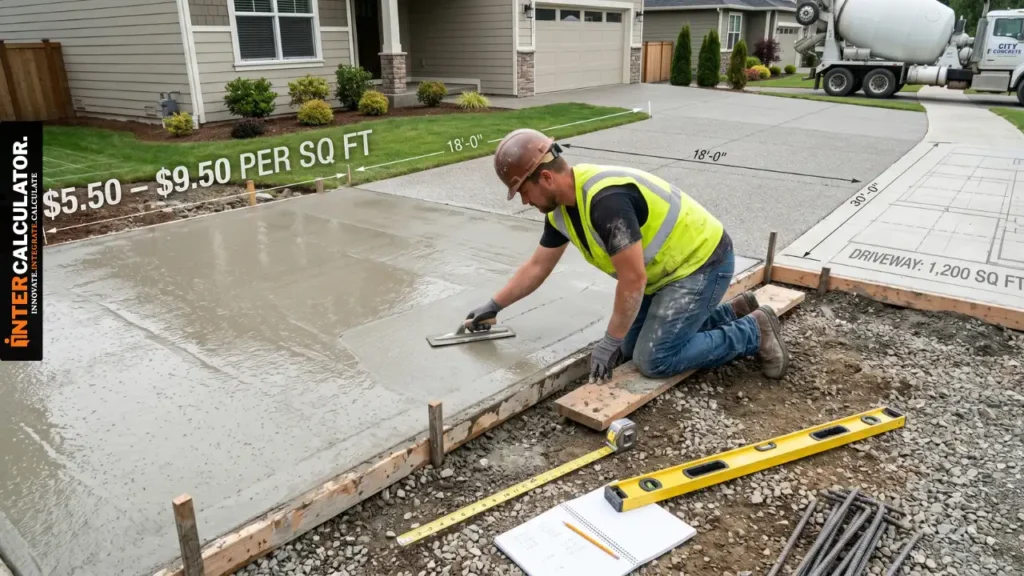
The national average cost of a concrete slab is $6.60 per square foot, that covers both materials and labor. For most home projects, you’ll likely pay somewhere between $4.34 and $7.73 per square foot. If your slab needs reinforcement like rebar or wire mesh, expect that number to climb to $9.29 to $10.04 per square foot.
Here’s a simple table to keep it clear:
| Slab Type | Cost Per Square Foot |
| Basic slab (low end) | $4.34 |
| National average | $6.60 |
| Reinforced slab | $9.29 – $10.04 |
Not sure what your total will be? You can plug your numbers into this free concrete cost calculator to get a quick estimate before calling anyone.
The size of your slab is honestly the biggest thing that changes your final bill. A small 10×10 shed pad costs a fraction of what a 30×30 garage floor runs. Here’s a fast look at common sizes and what you can expect to pay:
| Slab Size | Square Footage | Estimated Cost Range |
| 10×10 | 100 sq ft | $434 – $773 |
| 12×12 | 144 sq ft | $625 – $1,113 |
| 20×20 | 400 sq ft | $1,736 – $3,092 |
| 24×24 | 576 sq ft | $2,500 – $4,452 |
| 30×30 | 900 sq ft | $3,906 – $6,957 |
These are based on the national average price range of $4.34 to $7.73 per square foot. Bigger slabs cost more in total, but sometimes the cost per square foot actually goes down a little because contractors can work more efficiently on larger jobs.
When you get a quote, that number has two parts inside it, materials and labor, and knowing the split helps you spot a fair deal.
Concrete materials, the mix, gravel base, sand, and cement, typically run $3 to $7 per square foot. Labor adds another $3 to $5 per square foot, or roughly $45 per hour depending on your region.
The thing most people don’t realize is that labor makes up one-third to one-half of your total cost. So if a contractor seems expensive, it’s often the labor rate driving that, not the concrete itself.
To be fair, skilled labor is worth it. A properly poured and finished slab lasts 30 to 50 years. A rushed, cheap job can crack within a few seasons, and fixing that costs more than doing it right the first time.
If two contractors give you very different prices, it doesn’t always mean one is trying to cheat you. Most of the time, the difference comes down to a few key things, and once you know what they are, the quotes start to make a lot more sense.
I remember getting three quotes for a garage slab once. The prices were all over the place. But when I asked each contractor to break it down, the reasons became clear fast. Let me walk you through the big ones.
The thicker your slab, the more concrete you need, and that means more money.
A 4-inch slab is the most common for patios, walkways, and shed floors. It runs around $5.35 per square foot. That’s the sweet spot for light residential use.
Step up to a 6-inch slab, which most garage floors need, and you’re looking at about $6.19 per square foot. The extra thickness handles the weight of cars and heavy equipment much better.
For driveways that carry trucks or heavy vehicles, an 8-inch slab is sometimes needed, and the cost goes even higher. Honestly, going thicker than you need wastes money. But going thinner than you need? That’s how cracks show up two years later.
Size matters too, not just because bigger slabs use more concrete volume, but because they take more labor hours to pour, finish, and cure. A 10×10 patio and a 30×30 garage floor are not even in the same conversation price-wise.
If you want to figure out exactly how many cubic yards your project needs, this concrete calculator makes it simple.
This is the part most people forget to ask about, and it’s where quotes can jump fast.
Now, beyond what goes in the slab, what’s under it matters just as much.
Subgrade preparation includes grading the ground flat, compacting the soil, and laying a gravel base. This usually costs $1.00 to $2.50 per square foot on its own. If the soil is soft, sandy, or full of clay, you may need soil stabilization, which adds more cost but prevents the whole slab from sinking over time.
For commercial or heavy-load jobs, moisture barriers and engineered subgrade prep are not optional. They’re what keeps a warehouse floor from cracking under forklift traffic three years in.
And one more thing, site access. If a concrete truck can’t get close to your pour area, extra labor is needed to move the mix. Steep slopes, tight spaces, and remote locations all quietly push that final number up.
Most people searching for concrete slab costs already have a project in mind. They’re not just curious, they want to know what their specific job will cost. So let’s break it down by project type, because a patio and a house foundation are two very different things.
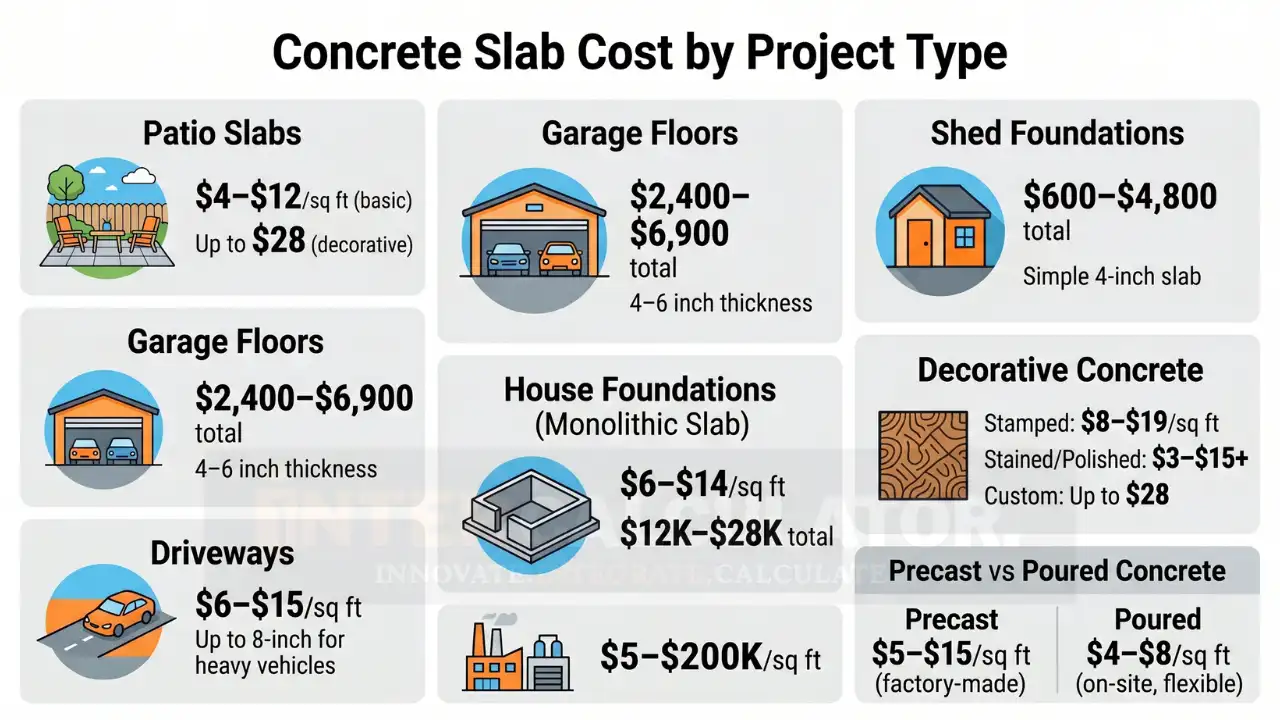
These are usually the most affordable place to start. A basic 4-inch slab with a simple broom finish runs $4 to $12 per square foot. It’s enough for outdoor furniture, a grill, a fire pit, everyday backyard use. If you want it to look nicer with stamped or decorative concrete, that price can climb all the way to $28 per square foot. Totally worth it if curb appeal matters to you, but it’s good to know upfront.
Garage Floors
These are a step up in both thickness and cost. A standard 2-car garage slab runs $2,400 to $6,900 total, depending on size and finish. Most garage floors need 4 to 6 inches of concrete to handle the weight of vehicles. A lot of homeowners also add an epoxy floor coating after the pour, it looks clean, resists stains, and makes the whole space feel more finished.
These are where thickness really starts to matter. Expect to pay $6 to $15 per square foot. If your driveway handles heavy trucks or SUVs regularly, 8-inch thickness is smart. Decorative options like colored concrete or stamped patterns push costs higher, but a plain broom finish keeps it practical and affordable.
These are the simplest and cheapest of the bunch, usually $600 to $4,800 total. A basic 4-inch slab with minimal reinforcement is all most sheds need. Honestly, this is also one of the few cases where a confident DIYer can seriously consider doing the pour themselves.
House foundations, specifically monolithic slabs
These are a completely different level. These run $6 to $14 per square foot, with total costs landing between $12,000 and $28,000 depending on size and soil conditions. They need steel rebar, a vapor barrier, and foam insulation underneath. This is not a cut-corners job. A bad foundation slab affects everything built on top of it, so experienced contractors and proper permits are non-negotiable here.
If you want your slab to look like more than just grey concrete, decorative finishes are where the magic happens, but they do add real cost.
Stamped concrete runs $8 to $19 per square foot installed. It can mimic the look of tile, slate, or marble and honestly looks great on patios and driveways. Stained concrete is a bit more affordable at $3 to $15 per square foot, and polished concrete falls in the same range, $3 to $15+ depending on how many passes the grinder makes.
Go full decorative with multiple colors, textures, and custom stencils and that number can hit $28 per square foot. The reason the price jumps is simple, decorative work takes more skill, more time, and specialized tools that not every contractor carries. Make sure whoever you hire has actually done it before.
This is a choice more people should think about before they commit to a contractor, and honestly, most guides skip right past it.
These are made in a factory, then delivered and placed at your site. Standard precast runs $5 to $15 per square foot. Specialized or custom designs can go up to $30. The quality is consistent because it’s made in a controlled environment, no weather delays, no on-site mixing problems.
But here’s the part people forget to ask about: delivery fees and heavy equipment to lift and place the slabs add real cost on top of that base price. According to research cited by Nitterhouse Concrete Products, precast concrete slabs can save around 23% compared to cast-in-place concrete, largely because the molds are reused hundreds of times, which lowers production costs significantly.
That saving sounds great. And for small, simple, uniform jobs, like a pre-made shed pad or garden stepping squares, precast genuinely makes sense.
This is the traditional method, and it’s still the better choice for most home projects. It’s flexible, it can be shaped, sized, and finished exactly the way your space needs. For larger slabs or anything with a custom layout, poured on-site is almost always more affordable once you factor in that delivery and crane equipment precast requires.
On-site poured concrete typically runs $4 to $8 per square foot and is the more common choice for full home foundations and larger projects, while precast is generally recommended for small, uniform applications.
My honest take? If you have a small, straight-forward job with no weird angles, precast can save you time and sometimes money. But for a garage floor, driveway, or house foundation, poured on-site almost always wins on both cost and fit. You also have more control over thickness, reinforcement, and finish type when it’s poured fresh at your site.
Want to estimate your cubic yards before deciding? Use this cubic yard calculator, it takes less than a minute.
Let me be straight with you here, this is the question where a lot of people make expensive mistakes.
Yes, doing it yourself saves money. Skipping labor cuts $2 to $3 per square foot off your total cost. On a 20×20 slab, that’s $800 to $1,200 back in your pocket. That’s real money. But that saving comes with a catch.
To pour a slab yourself, you need to rent tools, a concrete mixer, screed board, float, and forms at minimum. You need to understand subgrade prep, concrete mix ratios, and how to finish a surface before it sets. And concrete doesn’t wait for you to figure things out. Once it starts setting, you have a narrow window to get everything right. I’ve seen DIY slabs crack badly within one winter because the ground wasn’t compacted properly underneath. Fixing a bad slab costs more than hiring someone to do it right the first time.
Here’s my honest take on when DIY makes sense and when it doesn’t:
| Project | DIY or Pro? | Why |
| Shed foundation (small) | ✅ DIY possible | Simple, small, low-stakes |
| Short walkway or garden pad | ✅ DIY possible | Manageable size, low risk |
| Patio (10×10 to 12×12) | ⚠️ DIY with caution | Doable but requires prep knowledge |
| Garage floor | ❌ Hire a pro | Thickness, finishing, and load requirements matter |
| Driveway | ❌ Hire a pro | Traffic load, thickness, access all need expertise |
| House foundation | ❌ Always hire a pro | Permits, rebar, vapor barrier, no shortcuts here |
For anything bigger than a simple shed pad or short walkway, I’d strongly recommend hiring a professional concrete contractor. Get at least three quotes, ask whether permits are included in the price, and make sure the contractor spells out what the prep work covers.
Now here’s a smart middle ground that most guides don’t mention, do your own site prep and hire out the pour. Clearing brush, removing old material, and doing basic soil leveling yourself can shave a meaningful amount off the labor quote. The contractor shows up to a ready site, works faster, and you still get a properly poured and finished slab. Best of both worlds, honestly.
If you want to run the numbers before calling anyone, this free concrete cost calculator gives you a solid starting estimate in about a minute.
Concrete slab costs are not a mystery once you understand what drives them. Size, thickness, reinforcement, finish type, and site conditions, those five things explain almost every price difference you’ll ever see between quotes.
For most home projects, budget somewhere between $4 and $12 per square foot and you’ll be in the right ballpark. Add a 10% buffer for surprises, get at least three quotes from local contractors, and don’t skip the subgrade prep, that’s where most long-term problems start.
A well-poured slab lasts decades. Take your time planning it right, it’s worth it.

A basic 4-inch slab with a simple broom finish and no reinforcement is the most affordable option. For small projects like a shed base or short walkway, you can expect to start around $4 per square foot. Keep the shape simple, skip the decorative finishes, and do your own site clearing, that's how you keep the cost as low as possible.
A properly poured and finished concrete slab lasts 30 to 50 years under normal use. If you seal it regularly and take care of small cracks early, some slabs last well over 100 years. The biggest things that shorten a slab's life are poor subgrade prep, skipping reinforcement, and ignoring cracks before they spread. Take care of it and it'll take care of you.
It depends on your project and your local building codes. Foundations and any structural slab almost always need a permit, no way around it. A simple backyard patio usually does not. The honest answer is: don't guess. Call your local building department before you start. Getting caught without a permit can mean tearing the whole thing out and starting over, and that's a painful and expensive lesson.
This one confuses a lot of people, even some who've been around construction for years. Cement is just one ingredient. Concrete is the full mix, cement, sand, water, and aggregates like gravel all combined together. Cement alone is a powder. It's not something you pour or build with on its own. When someone says "cement slab," they actually mean a concrete slab. The two words get used wrong all the time, so now you know the difference.
It depends on what the slab needs to hold. Patios and shed floors work fine at 4 inches, that's enough for foot traffic and light loads. Garage floors and most driveways need 6 inches to handle the weight of vehicles. If your driveway carries heavy trucks, or you're pouring a house foundation, you're looking at 8 inches or more, and in that case, a structural engineer should confirm the right thickness based on your soil conditions and load requirements.